

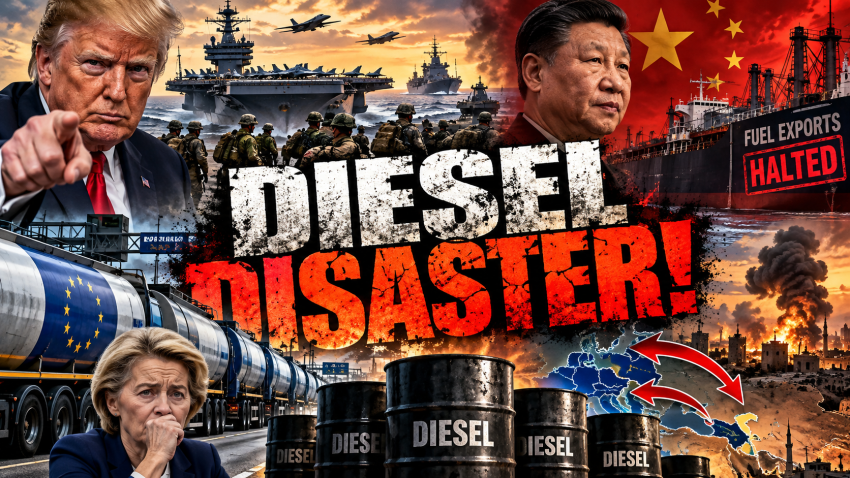
Diesel is the story of the moment. Escalating military moves in the Middle East, a blunt US warning to Europe, and China’s decision to halt fuel exports for October are tightening global supplies just as Northern Hemisphere winter approaches. The combination is already showing up in higher costs that flow straight into farm operations and the broader food chain.
Middle East Escalation
Iranian state media reported a 2.5 million barrel capacity supertanker hit and burning roughly 8 kilometers off the coast of Oman after what Tehran described as an attack on a vessel traveling through the Strait of Hormuz “illegally.” This follows the expiration of Iran’s 45-day deadline for the US to lift its naval blockade of Iranian ports.
The Pentagon is sending a third aircraft-carrier strike group and additional Marine Corps ships, adding 9,000 to 10,000 troops. The forces are expected in the region by the end of November. President Trump has indicated he may renew strikes on Iran after the midterm elections if no acceptable deal is reached. Three carriers and two landing groups could be positioned around Iran by late November. Oil prices jumped on the news. Refined product flows through Hormuz remain well below pre-conflict averages even as some crude volumes have recovered via dark tankers.
US pressure on Europe
President Trump said he discusses a potential diesel export ban “every day,” blaming Russia’s war in Ukraine for the squeeze. The administration has told Germany and France to release emergency diesel inventories or face a US export ban. The request is for 120 million barrels over six months, or about 660,000 barrels per day of additional supply.
US Energy Secretary Chris Wright said announcements from Europe are expected soon. Trump noted an export ban could hurt gasoline prices but lower diesel costs. Russia has already extended its own diesel export ban through October 31. Analysts warn the refining crisis could stretch into 2027, and elevated diesel prices risk an economic shock comparable to 2008. Sixteen US trucking companies filed for bankruptcy in less than a month as prices soared.
China’s export halt
Chinese refiners have suspended October fuel exports to rebuild domestic stockpiles. It is unclear whether exports will resume after the holiday ending October 7; the decision will depend on domestic inventories and refining output. China holds the world’s largest refining capacity, yet Beijing is prioritizing local supply security. Top destinations for recent Chinese fuel exports included Singapore, Malaysia, Australia, Vietnam, Bangladesh, and the Philippines. Asian diesel markets reacted immediately, with October-November swap spreads reaching two-week highs.
This resource nationalism adds to Russian export restrictions and Hormuz disruptions. Import-dependent countries face tighter competition for remaining barrels. Governments elsewhere may follow with their own protectionist measures ahead of winter.
What this means for farmers and the food supply chain
Diesel powers tractors, combines, irrigation pumps, grain dryers, and the trucks that move harvests from field to elevator to processor to retailer. Higher prices raise planting, harvesting, and hauling costs at every stage. Trucking bankruptcies already signal stress in the logistics layer that carries fertilizer, seed, feed, and finished food.
The squeeze arrives as winter demand builds and global refined-product inventories stay constrained. Any further disruption in the Middle East or additional export curbs would amplify the pressure. Farmers face tighter margins on the cost side while consumers eventually see higher prices for everything that moves by diesel-powered transport. The food supply chain is not insulated from an industrial-fuel crisis this broad.