

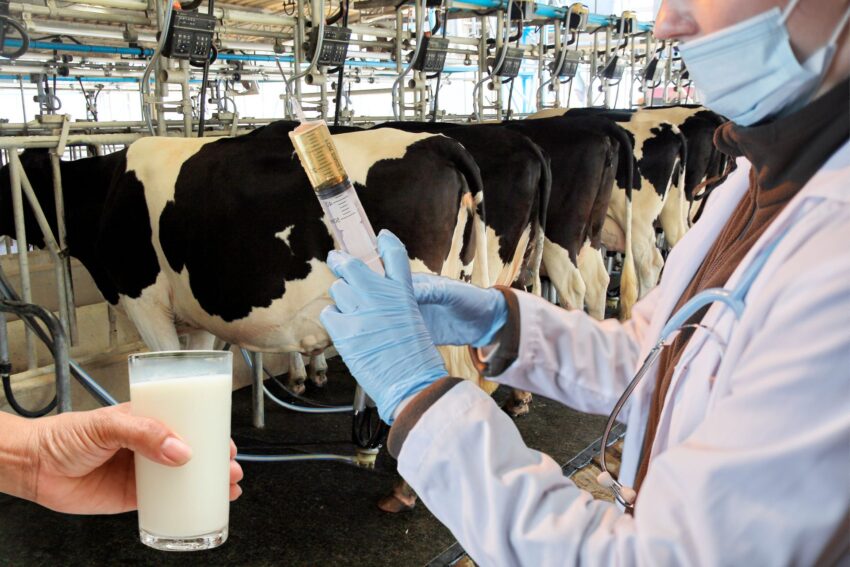
Farmers in France are now hiding their cattle from government forces. Police deploy thermal imaging drones to spot the animals. Once located, squads of gendarmes and vaccine teams swarm the property and forcibly inject the herd. Video footage from a recent raid shows a tense standoff on a rural farm, with farmers confronting officers while the cattle graze nearby. This is not fiction. It is the latest escalation in France’s response to lumpy skin disease. Last year the government declared vaccination mandatory across entire regions. It deployed the army for mass inoculation drives and used police to enforce culls of affected animals.
Unbelievable! French police are now using thermal imaging drones to locate cattle hidden by farmers who refused mandatory vaccination.
Once located, squads of gendarmes and vaccine teams swarm the property to forcibly inject the animals. Video from one such raid last week shows… pic.twitter.com/gOMO2gSSSR
— Ben Swann (@BenSwann_) April 22, 2026
The French government claims these measures protect livestock and the public. Yet the heavy-handed tactics reveal a deeper agenda of total control over what enters the food chain. Farmers who resist face raids on their private property. Their animals receive injections whether they consent or not. When the state decides what gets injected into the nation’s herds, whose rights matter anymore?
This is not an isolated incident in France. It signals an alarming trend spreading worldwide. Governments increasingly turn to mandatory vaccination programs for livestock during disease outbreaks. In France alone, authorities launched a massive campaign to vaccinate hundreds of thousands of cattle against lumpy skin disease in late 2025. Similar compulsory efforts target poultry for highly pathogenic avian influenza, with mandatory vaccination required on commercial duck farms exceeding 250 birds. These programs treat farmers as obstacles rather than stewards of the land.
The pattern mirrors what happened with humans during the COVID era. Authorities pushed deadly COVID vaccines on populations with aggressive mandates, censorship of dissent, and dismissal of safety concerns. Billions received shots despite mounting evidence of harm. Now the same playbook applies to animals. Governments assert control over cattle, pigs, poultry, and other livestock under the guise of public health. The message is that compliance is mandatory, resistance is futile.
The risks extend far beyond France. Outbreaks of foot-and-mouth disease or avian flu could trigger identical responses in the United States and other nations. The U.S. Department of Agriculture already maintains stockpiles of foot-and-mouth disease vaccine and explores vaccination strategies for highly pathogenic avian influenza. Emergency plans exist that include widespread inoculation campaigns. If a major outbreak strikes American farms, federal and state authorities could impose mandatory programs with the same drone surveillance, police enforcement, and property intrusions seen in France. Farmers who value their independence and the health of their herds would face the same raids and forced injections.
The dangers are real and immediate. Livestock vaccines carry side effects just as human ones do. Injected animals may suffer adverse reactions, reduced fertility, or long-term health issues. Those problems do not stay on the farm. Meat, milk, and other products from vaccinated animals enter the global food supply. Consumers have no reliable way to know what their dinner once received. Residues or unintended consequences could affect human health downstream. History shows that rushed mass-vaccination programs prioritize speed over safety. When those programs target the animals that feed the world, the stakes could not be higher.
Independent farmers and small operations bear the brunt. Large agribusinesses may absorb the costs and comply without protest. Family farms that prioritize natural methods and animal welfare get steamrolled. Property rights erode when the state can invade land with drones and armed teams to enforce medical procedures on livestock. Food security weakens when governments override the very producers who understand their herds best.
France offers a preview of what could unfold across Europe, North America, and beyond. Lumpy skin disease prompted the current crackdown. Avian flu or foot-and-mouth disease could justify the next wave. Global health organizations and national governments already coordinate responses to transboundary animal diseases. Low vaccination coverage for many livestock threats exists today, but that gap is closing fast through top-down mandates rather than voluntary adoption.
pnas.org
AgroWars readers understand the stakes. Centralized control over agriculture leads to higher costs, lower quality, and greater vulnerability. When governments force substances into animals that supply the food chain, they gamble with public health and farmer livelihoods. The solution lies in rejecting these overreaches. Support farmers who resist. Demand transparency on vaccine ingredients and long-term studies. Insist that animal health decisions remain with owners, not bureaucrats with drones and squads.The trend is clear and accelerating. France is just one example. If left unchecked, forced animal vaccination will spread to the United States and beyond for foot-and-mouth disease, avian flu, and whatever crisis comes next. The food supply depends on stopping it now.