

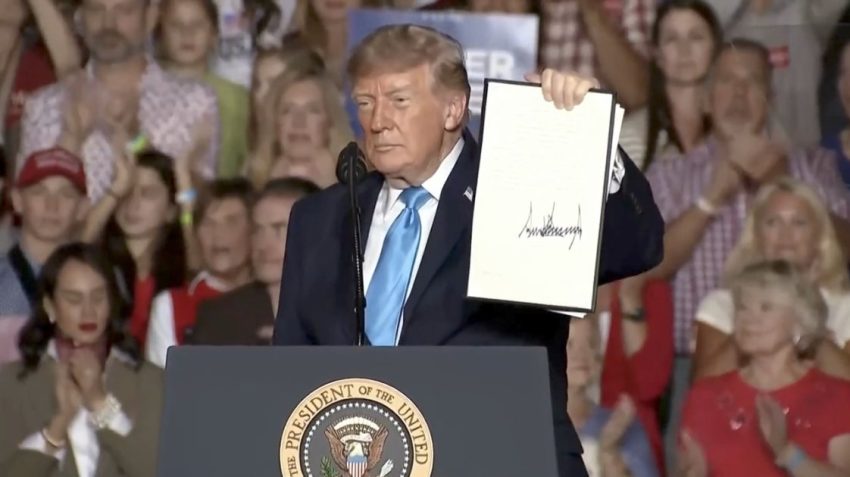
President Donald Trump stood in Grand Island, Nebraska, on October 5 and signed an executive order letting people temporarily buy red-dyed diesel for highway use while deferring the federal excise tax through the end of the year. The White House called it historic relief for farmers, truckers, and workers. It is not. It is a thin, temporary tax holiday sold as salvation right before the midterms.
Dyed diesel is the same fuel as clear diesel. It is simply dyed red and sold without the federal highway tax of 24.4 cents per gallon when used off-road in tractors, combines, construction equipment, and heating. Law has long banned its use on public roads to protect the Highway Trust Fund. Trump’s order directs Treasury to defer that federal tax on highway use of dyed diesel until December 31, with no interest or penalties, and to explore ways to wipe out the deferred bill later. The IRS is told not to impose the usual dyed-fuel penalties in the meantime. It also prods states to match the move and asks the USDA to protect farmers’ access to the limited supply of red diesel.
For farmers, the practical effect is modest. Off-road equipment already ran on tax-free dyed diesel. The change mainly helps the grain trucks, cattle haulers, and pickups that move harvest and inputs on public roads. Where states also suspend their own restrictions and taxes, a large fill-up can avoid the combined tax bite. The White House claims savings of more than $100 per refill for truckers. Federal tax alone on a 250-gallon tank is about $61. State taxes average another 30-plus cents in many places, so the full break can approach or exceed that $100 figure if retailers actually lower the pump price and if dyed diesel is available.
That is the entire pitch. A few dozen cents a gallon for the final weeks of 2026, on fuel that may still carry an IOU if the deferred tax is never forgiven. Retailers who sell the dyed fuel often remain the ones on the hook for the tax. Interstate carriers still face state fuel-tax systems the order does not touch. Supply of red diesel is not infinite; sudden demand from highway users could strain the very tanks farmers need for harvest equipment. Experts have already noted the relief will not be widespread or automatic.
Now look at the price of diesel itself. The national average has hovered near or above $6.20 a gallon in early October, after peaking around $6.53 in September. That is roughly double the levels seen through much of the Biden years and early in Trump’s second term. Annual averages ran $3.29 in 2021, $4.99 in 2022, $4.21 in 2023, $3.76 in 2024, and $3.66 in 2025. The jump tracks the war with Iran that began in late February 2026, compounded by disruptions to Russian refined product exports. Diesel rose from about $3.76 before the Iran conflict to record highs. Farmers and truckers have been paying the difference for months while margins tightened and harvest costs soared.
Twenty-four cents is not nothing when you run thousands of gallons. It is also nowhere near enough to offset a fuel bill that roughly doubled. The order arrives after the damage is done, timed for a campaign stop in farm country weeks before the November 3 midterms. It is a classic pre-election gesture: let the peasants keep a little more of their own money by not collecting Caesar’s small cut on diesel for a short window, then declare victory. States had already begun their own suspensions. The federal move simply piles on with a temporary deferral and a hope that Congress might later erase the bill.
If Biden had steered the country into a grinding, open-ended conflict that sent diesel to $6.50, Trump would have spent every day on the attack. The phrase “disastrous quagmire” would have been permanent. Skyrocketing energy prices would have been Exhibit A in the case against the previous administration. Instead, Trump owns this war and its price tag. He has repeatedly framed the elevated fuel costs as a “small price to pay” for keeping nuclear weapons out of Iranian hands. At the same Nebraska rally where he signed the diesel order, he offered the now-infamous line about Iran being able to “take out a city” and “let ’em take out Los Angeles, let ’em take out San Diego,” calling it a small price. The White House insists he meant the opposite: that without the war those cities would have been at risk. The phrasing was careless enough to spark immediate outrage, and the underlying argument remains the same: higher diesel is the acceptable cost of the policy.
Farmers are not supposed to notice the contradiction. They are supposed to accept a temporary tax deferral as proof that the administration is looking out for rural America. The order does not restore the diesel prices of 2024 or 2025. It does not end the supply disruptions. It does not change the fact that the man who promised lower costs delivered a war that drove them to records and is now offering a short-term break on a 24-cent tax as compensation. It is far too little and far too late. It is political damage control dressed up as farm relief. Rural voters can judge for themselves whether a deferred tax on red diesel is worth the price already paid.