

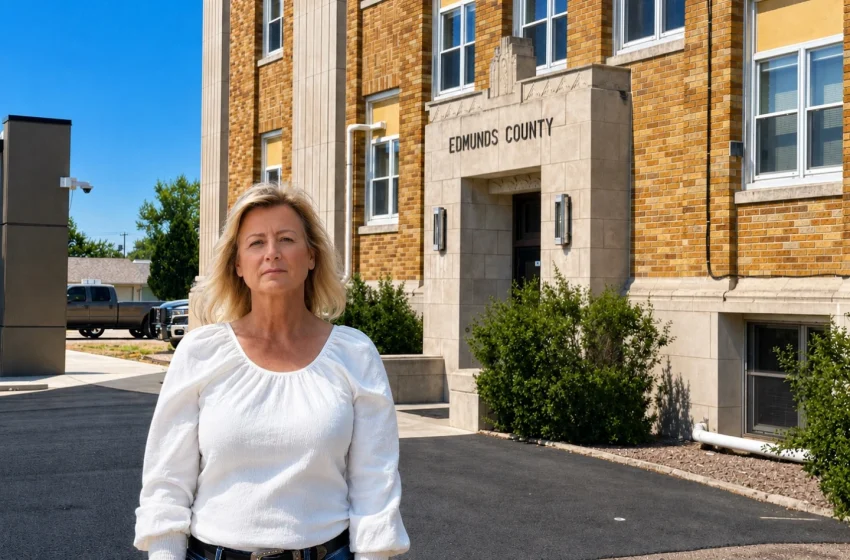
Julie Burgod asked questions about a 25,000-head mega-dairy planned for her small South Dakota county. Less than a day after she laid those questions out in public, a Division of Criminal Investigations agent showed up at her office two hours from home, carrying her zoning complaint and her voter registration. Neighbors who signed her petition to run for county commissioner got visits too.
This is what it looks like when industrial agriculture and government power move as a pair, and a local farmer will not get out of the way.
Burgod is a fourth-generation Edmunds County farmer. She grows corn and soybeans, runs a cow-calf operation with her husband Keith and their two sons, and works as an owner-agent at a crop insurance office in Aberdeen. She won her primary in June and takes office as county commissioner in January. She is not a professional activist. She is the person who lives next to the land, the roads, the water, and the ordinances that are supposed to apply to everyone.
The project she challenged is Belle Dairy, a Riverview LLP proposal out of Minnesota. It would put 25,000 dairy cows on a few hundred acres in a county of about 4,000 people. Existing dairies in Edmunds County are nothing like this scale. Locals submitted hundreds of comments, a thick binder of concerns, a 346-signature petition asking for denial, and tens of thousands of acres where landowners refused manure agreements. The zoning board approved it anyway. Burgod has said the county expected $4.3 million tied to the Governor’s Office of Economic Development.
She did not just complain in a Facebook group. She read the application. She compared cow weights, manure estimates, and available acres against the county ordinance. She reported possible ordinance violations on July 14. She delivered a formal complaint to the Zoning Board on July 20. On July 29 she stood at a County Commissioner meeting and laid out the problems. On July 30, DCI agent Darin Sinner arrived.
Chris Bennett at AgWeb has documented the sequence in detail, first in “Targeted? South Dakota Farmer Criminally Investigated After Questioning Mega-Dairy Construction,” then in the follow-up “Coincidence? Investigation of SD Farmer is Unrelated to Agriculture, State Claims.”
The state’s new line is that none of this had anything to do with agriculture, zoning, a dairy, or lagoon runoff. Officials say local authorities asked for a look at a residency complaint involving Burgod’s address as a candidate and her owner-occupied tax status. DCI reviewed it, offered her a chance to be heard, decided it was not a criminal matter, and sent findings to the Department of Revenue.
Burgod’s response is blunt. “They can say anything they want, but it’s obvious what is going on here.”
She notes the narrative shifted to property tax after the fact. That issue was never raised with her during the visit. The agent had her voter registration and the zoning complaint she filed against the dairy. DCI also checked the neighbors who signed her commissioner petition. “How do these actions relate to owner occupied status?” she asked.
If this were really a local tax or residency paperwork problem, why did it jump to the Attorney General’s criminal investigators instead of staying with the county auditor, the director of equalization, or the zoning office? Why was it not flagged when she filed her candidate petition in March? Why did her certified-mail request to the AG’s office for the complaint details and the complainant’s name go unanswered?
Those are not conspiracy theories. They are the questions any reasonable person asks when the timing is this tight and the documents in the agent’s hand are this specific.
Mega-dairies of this size are not just another farm next door. They concentrate animals, water demand, manure, truck traffic, and political leverage. When the numbers in an application do not line up with ordinance requirements, the people who live there have a right to demand a review. That is not extremism. That is self-government in a rural county.
What happened after Burgod used that right is the part that should bother every independent producer. A woman who farms, sells crop insurance, and just won an election gets a state criminal investigator at her office door. The people who signed her petition get questioned. Then the official story becomes: nothing to see here, just a tax form.
Big operations do not need to send a letter on company letterhead when they can rely on the machinery of the state to make a challenger think twice. The dairy still needs state permits. The county already voted. The farmer who kept asking about acres and manure volume is the one who got investigated.
Burgod put it simply: she thought the attorney general’s office existed to protect citizens and taxpayers. She asked why a property tax question needed to be elevated to that level. She asked why residency was not handled when she filed in March if it was such a problem.
Those questions still do not have a clean answer. The AgWeb reporting makes the timeline and the documents hard to ignore. Readers can judge the “coincidence” for themselves.
Family farmers who speak up about scale, ordinances, water, and manure should not need a lawyer on speed dial the next morning. If this is how South Dakota treats a commissioner-elect who did her homework, the message to the next person in the next county is clear. Sit down. The project is coming either way.