

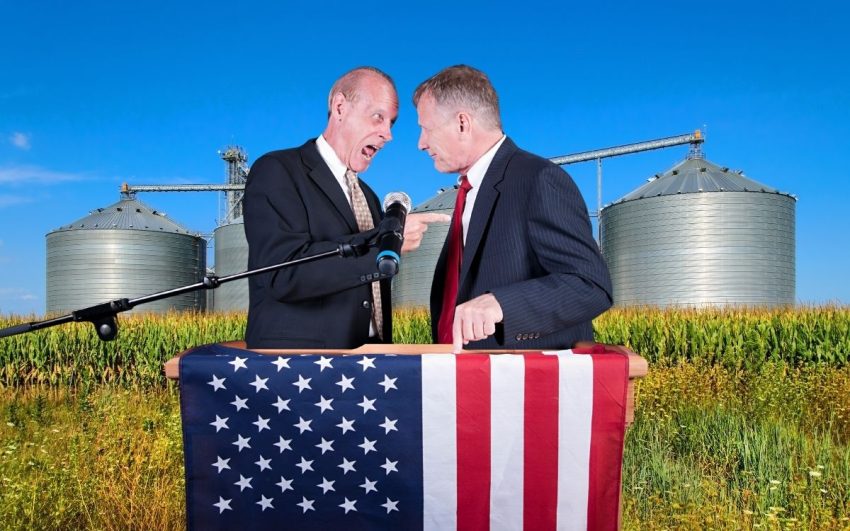
For generations, rural America has largely aligned itself with conservative politics because farmers tend to value independence, local control, property rights, free enterprise, and limited government interference. Many producers believed the Republican Party represented those priorities. Increasingly, though, there is a growing feeling across farm country that neither party truly represents the people working the land.
Farmers today are caught in the middle of forces far larger than agriculture itself. Trade disputes, foreign wars for foreign interests, inflation, high interest rates, rising fuel costs, and uncertainty in export markets have all created pressure on operations that already run on thin margins. Rural Americans are watching Washington argue endlessly while family farms continue consolidating into fewer hands and younger generations struggle to afford entry into agriculture.
At the same time, many producers worry that if political momentum shifts sharply in the next several election cycles, which it likely will given the unpopularity of Trump and his administration amongst young conservatives and independents, a new wave of aggressive environmental and climate-related policies could return to the national agenda. Carbon reporting requirements, emissions standards, restrictions tied to livestock production, and pressure to convert farmland into ‘renewable’ energy infrastructure remain major concerns throughout farm country.
In Europe, some livestock producers have already protested regulations tied to emissions reductions and feed additives intended to reduce methane output. Those debates have become cautionary examples for American producers who fear policymakers increasingly disconnected from agriculture could attempt similar approaches in the United States without fully understanding the economic and biological realities of farming.
These fears are not simply about politics. They are about survival, autonomy, and whether rural communities will retain control over how food is produced in America.
What has frustrated many farmers most is the sense that neither political party is seriously confronting the deeper structural problems facing agriculture. Republicans often campaign as defenders of rural America, yet many producers feel trade instability, ballooning debt, corporate concentration, and foreign policy conflicts have left the country economically weaker and more divided. Democrats, meanwhile, continue to struggle connecting with rural voters culturally and economically, even when addressing legitimate concerns about infrastructure, healthcare, or market fairness.
The result is a growing political homelessness in rural America.
Farmers do not want lectures from urban activists who have never set foot in a feedlot or climbed into a tractor cab. They also do not want slogans from politicians who appear during election season and disappear afterward. They want stable markets, affordable fuel, strong infrastructure, fair trade, local opportunity, and the freedom to operate without constant interference from distant bureaucracies or multinational interests.
Historically, when rural Americans felt ignored, they organized. The farm crises of the 1970s and 1980s produced demonstrations, tractorcades, and grassroots political movements that forced the rest of the country to pay attention to conditions in agriculture. Those protests reflected a deeper concern that the people feeding the nation no longer had a meaningful voice in shaping its future.
That same frustration appears to be building again today.
Whether it leads to political reform, new third-party movements, stronger state-level organizing, or renewed farmer activism remains to be seen. What is clear is that many producers increasingly believe the current political system no longer reflects the priorities of rural America.
And when enough people who feed the country begin feeling politically orphaned, the consequences rarely stay confined to the countryside.