

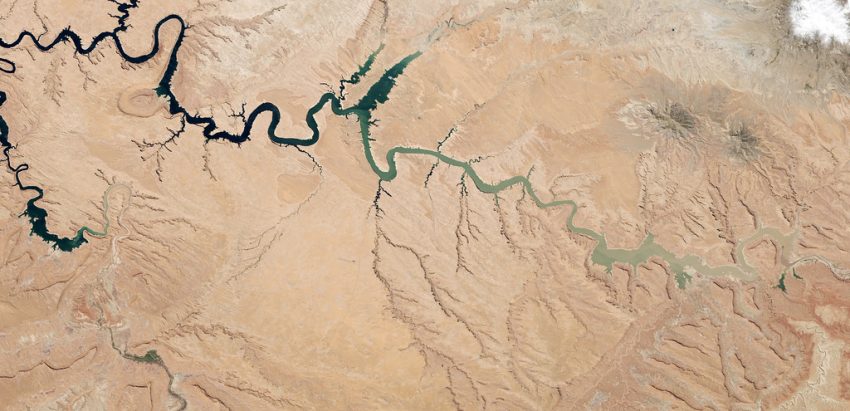
The states that depend on the Colorado River face an absolute disaster. Lakes Mead and Powell, the twin giants that store the system’s water, have crashed to record or near-record lows in 2026. Combined storage sits at roughly a quarter of capacity. Inflows keep missing, snowpack keeps disappointing, and the river no longer delivers what the 1922 Compact promised. Arizona, California, and Nevada are taking deep cuts. Farmers and ranchers watch fields go dry. Households hear the word “ration.” Meanwhile, the same region races to host massive data centers that drink both water and power.
The drought is real. The shortages are real. Yet growing numbers of people refuse to accept the official story of simple climate change plus overuse. They point to patterns that look too convenient.
Iran publicly accused the United States of engineering drought against it. Iranian voices claimed U.S. radar installations were part of the mechanism. Those installations were struck. Shortly afterward, parts of Iran received heavy rains after years of scarcity. Official meteorology and fact-checkers dismissed any causal link. Radars observe, but they do not command clouds, or so we are told. Still, the sequence fed a larger suspicion: weather can be influenced, and powerful states have studied how.
“He who controls the weather, will control the world.” – Lyndon Johnson
Cloud seeding is not fringe. It is practiced openly in the American West, the UAE, China, Iran, and elsewhere. Silver iodide and other agents are released into existing clouds to coax more precipitation when conditions allow. Results are usually modest, five to fifteen percent under the right setup. Governments and private operators have run these programs for decades. Broader geoengineering concepts, aerosol injection, marine cloud brightening, remain experimental, but the research exists and the interest is documented. Historical U.S. military programs once used weather as a weapon, including Operation Popeye in Vietnam. International treaties later restricted hostile environmental modification.
So the question hangs: could weather modification techniques have been applied, quietly and over years, against the Colorado Basin? Could the same technologies used to squeeze a few extra inches of snow in the Rockies also be used to suppress moisture elsewhere, or simply left idle while natural drought was allowed to deepen for other reasons? No public smoking gun proves large-scale weather warfare against the Southwest. The energy in the atmosphere is enormous. Yet the absence of proof is not proof of absence when the programs themselves are often opaque and the beneficiaries of scarcity are easy to identify.
But is there another culprit?
Look at the data centers. Hyperscale facilities for AI and cloud computing are pouring into the water-starved Southwest, especially around Phoenix. They need continuous cooling. A single medium-sized center can consume tens or hundreds of millions of gallons a year. The real multiplier comes from the power plants that feed them. Thermal generation, natural gas or otherwise, uses still more water for its own cooling. Projections for Arizona and neighboring states show billions of gallons of combined demand within a decade. That water comes out of the same stressed system that is already forcing farmers to fallow land and cities to preach conservation. The centers are not the largest users yet. Their growth rate and political protection make them the newest and most politically favored claimants.
Americans are told to shorten showers and skip the lawn. Producers lose crops and livestock. Capital builds thirsty machines in the desert. The administration and its big-tech backers push these projects hard. Water for servers is treated as infrastructure. Water for food is treated as negotiable.
Who benefits, and why? The Soviet Union engineered the Holodomor by seizing grain, sealing borders, and letting millions starve so that political control and industrialization could advance. Intentional scarcity as policy is not new. Let’s now consider what has been happening in the US. Open borders in the United States have been allowed to remain chaotic for years despite clear costs in security, wages, and social trust. When a government repeatedly acts against the long-term interests of its own population while protecting concentrated capital and preferred industries, the simplest explanation is that it serves the people who hold the purse strings rather than the people who live under its authority.
Perhaps the Colorado crisis is pure side effect of greed and short-termism. Over-allocation, hotter temperatures, evaporative losses, and new industrial demand can destroy a river system without any secret weather program. Many observers, however, look at the timing, the priorities, and the historical willingness of powerful states to experiment with environmental tools, and they wonder whether something more deliberate is at work. If the goal is to move water and energy toward data infrastructure, urban growth, and favored industries while agriculture and ordinary households absorb the pain, the outcome looks the same either way.
Maybe they just want rural America to move into the 15-minute cities the WEF has been talking about.
Regardless, he river continues to fall. The reservoirs set new lows. Farmers wait. Residents wait. The data centers keep rising. The official explanations emphasize climate and overuse. The unofficial questions keep asking who turned the valve, who profits from the dry, and how long the people of the Southwest are expected to ration while the servers stay cool.
Rain may come. Or it may not. In the meantime the pattern is clear enough for anyone willing to see it.