

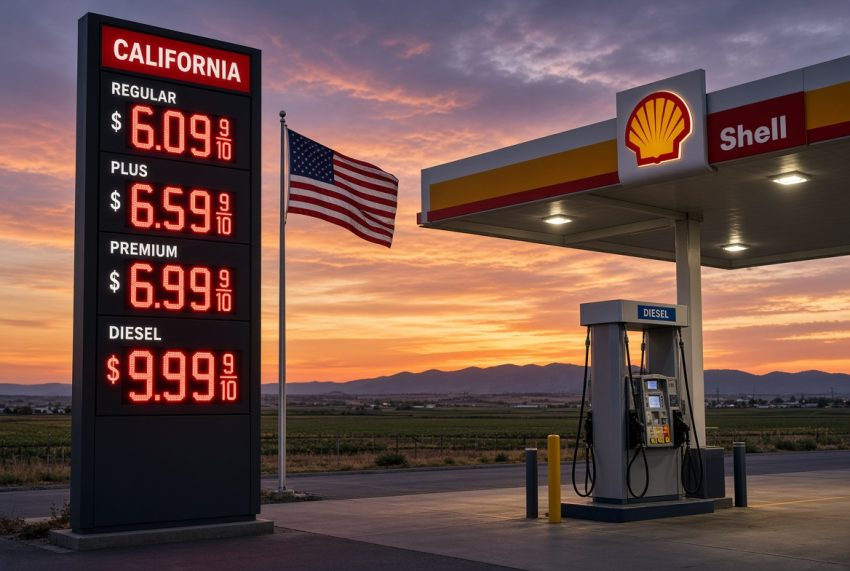
California gas station signs were never designed for the American golden age. Those digital displays, capped at a cheerful $9.99 per gallon, assumed a world of relative normalcy. They did not account for the cost of projecting power across the Middle East and Eastern Europe. Now the arithmetic is catching up, and farmers are feeling it first.
As of mid-September 2026, California’s average diesel price sits around $8.21 a gallon according to AAA data, with some stations already flashing the maximum $9.99. A few have simply run out and posted the number as a polite “sorry, empty.” Others are still pumping at or near that ceiling. The hardware has hit its limit. The market has not.
For context, this is not a gentle climb. California’s on-highway diesel averaged under $5 for much of 2025. The previous modern high hovered near $7 in the early months of Russia’s full-scale war in Ukraine. Go further back and the numbers look like science fiction: statewide averages around $1.10 in the late 1990s, $2 to $3 through much of the 2000s, and only occasional spikes above $4 before the pandemic era. Even the 2008 oil shock and the 2022 Ukraine-driven surge look modest next to today’s climb. Year-over-year, California diesel is up more than $2.80 in places. National averages have broken $6 for the first time.
The drivers are not mysterious. The U.S. conflict with Iran has effectively constrained the Strait of Hormuz for months, disrupting crude and refined product flows from the Persian Gulf. Middle Eastern diesel exports have collapsed. At the same time, Ukrainian strikes on Russian refining capacity prompted Moscow to ban diesel exports, removing another major slice of global supply. Russia previously accounted for roughly a tenth of seaborne diesel trade. Combine those shocks with California’s unique CARB formulation requirements, high state taxes, limited local refining capacity, and the usual West Coast logistics premiums, and the pump price does what it does.
Farmers are next in the blast radius. Harvest season runs on diesel. Tractors, combines, grain carts, trucks hauling to elevators: all of it burns the stuff by the tankful. A large operation can go through hundreds of gallons a day when the weather window opens. At $8-plus, and with individual stations already testing $10 territory, the fuel bill alone can erase thin margins. Input costs for fertilizer and other petroleum-linked products have not been kind either. The result is simple: higher production costs get passed along. Americans will “eat” the difference at the grocery store, the restaurant, and every other place food appears.
There is a certain dark comedy in the situation. “Freedom is not free.” It turns out we pay an arm and a leg, slaving away for it, and sometimes a full tank that starts to feel like an ounce of gold. With gold trading near $4,300 an ounce these days, a big equipment fill-up at elevated diesel prices is no longer a joke. The signs at the station may max out at $9.99, but the real price has no such hardware limit. Stations can post higher numbers on the pump itself or simply refuse to sell when the math gets absurd.
When does the average break $9.99 statewide? No one can time it precisely. Seasonal harvest demand, further disruptions in the Strait or additional Russian export restrictions, and any new hits to refining capacity could push California averages past $9 within weeks if the current trajectory holds. Some individual stations have already arrived. Others will follow as inventories tighten and crack spreads remain extreme. Analysts have noted that diesel tends to peak with fall agricultural activity; this year the geopolitical overlay makes that peak uglier.
The broader point is not about California’s unique fuel rules, though those amplify every shock. It is about the real cost of sustained conflict with energy-producing regions. Diesel is the workhorse of the physical economy: farming, trucking, shipping, construction. When it spikes, everything downstream gets more expensive. Consumers notice first at the supermarket. Farmers notice first in the field, calculating whether the next pass with the combine still makes sense at these prices.
The signs were not built for this. Neither were the budgets of the people who grow the country’s food. The golden age of high diesel has arrived, and the only question left is how high the numbers climb before someone invents a four-digit display or the conflicts that feed the prices finally ease. Until then, fill carefully, and budget for the privilege of keeping the lights on and the plates full. Freedom’s invoice is due at the pump.
This is the price of freedom, libtard!
We can’t let Israel’s enemy say mean words without bombing the hell out of them.
Are we winning yet, son?