

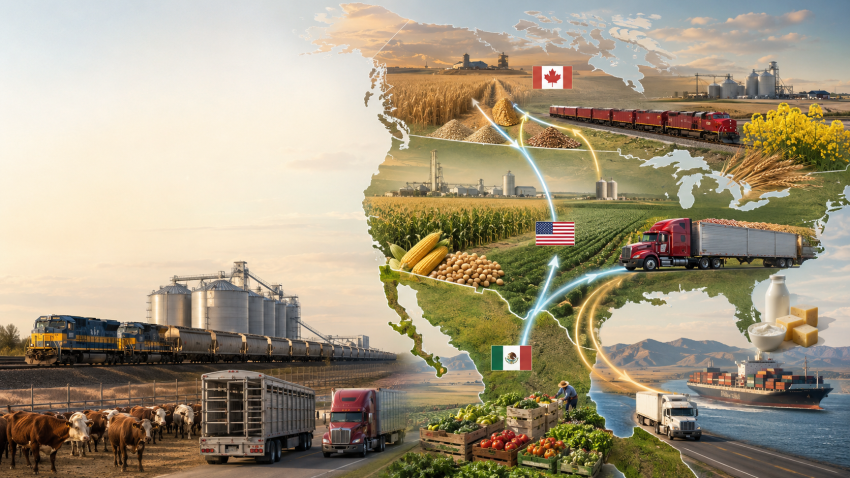
The United States-Mexico-Canada Agreement (USMCA) faces a critical joint review in July 2026. President Trump has signaled strong reservations about simply renewing the deal he negotiated in his first term, raising questions for American agriculture. Many farmers and ranchers view seamless access to these neighboring markets as essential for their livelihoods.
Trump’s Stance: America First and Fixing Imbalances
President Trump has stated he is “not looking to renew” the USMCA as is. He criticizes persistent trade deficits with Mexico and Canada, arguing the United States does not need their goods while they rely heavily on American markets. “They have to treat us better,” he has said.
This approach fits his broader strategy of using tariffs and negotiation pressure to address issues such as trade imbalances, Chinese circumvention through Mexico, border security, fentanyl flows, and manufacturing reshoring. The review, built into the agreement with a potential six-month withdrawal notice, gives the administration leverage to seek targeted changes or bilateral adjustments rather than a straightforward extension.
Trump’s team has highlighted concerns like auto rules of origin, non-trade issues, and enforcement. While withdrawal remains unlikely as a final outcome, the threat serves as a powerful bargaining tool.
Agriculture’s Heavy Reliance on USMCA Partners
Canada and Mexico together represent roughly one-third of U.S. agricultural exports, valued at around $60 billion in recent years. These markets have grown significantly under the agreement. From 2020 to 2024, U.S. ag exports to these partners rose 47 percent, compared to just 18 percent to the rest of the world.
Key exports include corn, soybeans, ethanol, meat, dairy, grains, and processed products. Mexico has become a top destination for many commodities, often surpassing China in importance for certain sectors. Integrated supply chains allow efficient movement of livestock, feed, fruits, vegetables, and inputs across borders.
Economic Multiplier for Rural America
The stakes extend far beyond farm gates. In 2024 alone, agricultural and seafood exports to Canada and Mexico supported $149 billion in total U.S. economic output, nearly 500,000 jobs, $36 billion in wages, and $64 billion in GDP contribution. Each dollar exported generated an additional $2.45 in broader economic activity.
These benefits ripple through rural communities, supporting processors, transporters, equipment dealers, and local services. Ag groups note that USMCA provides predictability for planting and investment decisions made months or years in advance.
Farmer Perspectives: Stability Over Uncertainty
A broad coalition of more than 150 agricultural organizations is urging renewal with targeted improvements. Farmers emphasize that disruption would be “catastrophic” or a “self-inflicted wound” amid current market pressures.
Jamie Beyer, a Minnesota soybean farmer, stressed the need for “wholehearted preservation” of the deal. Others highlight streamlined rules, better dispute resolution, and expanded dairy and poultry access to Canada as clear wins over the old NAFTA. While acknowledging issues like Canadian supply management or Mexican biotech compliance, producers largely favor certainty.
Uncertainty from tariffs or renegotiation could trigger retaliation, raise costs, and force producers into more volatile global markets without preferred North American access.
Looking Ahead: Targeted Fixes or Risky Disruption?
The July 2026 review offers a chance to address legitimate concerns such as stronger enforcement, reduced circumvention, and better market access in remaining protected sectors. Many in agriculture support smart updates that preserve core benefits.
For U.S. farmers, the USMCA is more than a trade pact. It underpins integrated North American food production that keeps costs down and demand steady. As talks intensify, rural voices urge policymakers to prioritize stability and export growth alongside fairness. The outcome will shape rural economies for years to come.