

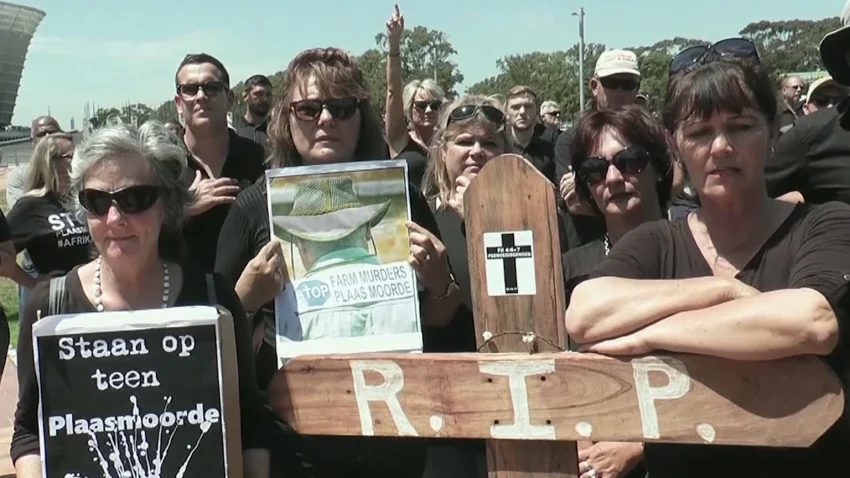
Tucker Carlson recently sat down with Leon Lotz, a South African farmer and former military serviceman, to highlight a crisis that much of the mainstream media continues to dismiss or ignore. Lotz’s account is personal and devastating. In 2010, eight armed attackers stormed his in-laws’ farm. They murdered his father-in-law, severely assaulted his mother-in-law, and raped his wife Adel in front of their children. Lotz has endured multiple farm attacks himself and now speaks openly about the violence that continues to strike South Africa’s farming communities.
These attacks are not abstract statistics. They involve extreme brutality that goes beyond ordinary crime. Farmers and their families have been tortured, burned, and killed in ways that leave survivors permanently scarred. Yet international coverage often labels discussion of the problem a “racist conspiracy theory” or “White genocide myth.” Official narratives emphasize that South Africa suffers from high overall violent crime affecting all groups, and that farm murders form only a small fraction of total killings. What receives far less attention is the particular vulnerability of commercial farmers, the disproportionate impact on White-owned farms that produce much of the country’s food, and the political climate that tolerates or excuses the violence.
Chants of “Kill the Boer, Kill the Farmer” are still performed at political rallies. Defenders call it a historical freedom song from the anti-apartheid era that should not be taken literally. When farm attacks occur with such frequency and sadism, those words cannot be waved away as harmless symbolism. They form part of an atmosphere in which rural White communities feel targeted and abandoned.
The parallel with Zimbabwe (formerly Rhodesia) is hard to ignore. There, the forced removal of White farmers from productive land led to agricultural collapse, widespread hunger, and economic ruin. Authorities later sought to bring some of those farmers back. Only a limited number have returned, often in reduced roles. South Africa risks following a similar path if the security of its remaining commercial farmers continues to erode. Food production depends on people who are willing and able to work the land. Driving them off through violence or fear produces the same outcome seen next door: empty fields, empty shelves, and national decline.
Carlson’s interview does what much of the press refuses to do. It lets a survivor speak without filters. The story of Leon Lotz and others like him is not a conspiracy. It is a warning. Farm attacks remain a real and horrifying reality in South Africa, and ignoring them will not make the danger disappear.
