

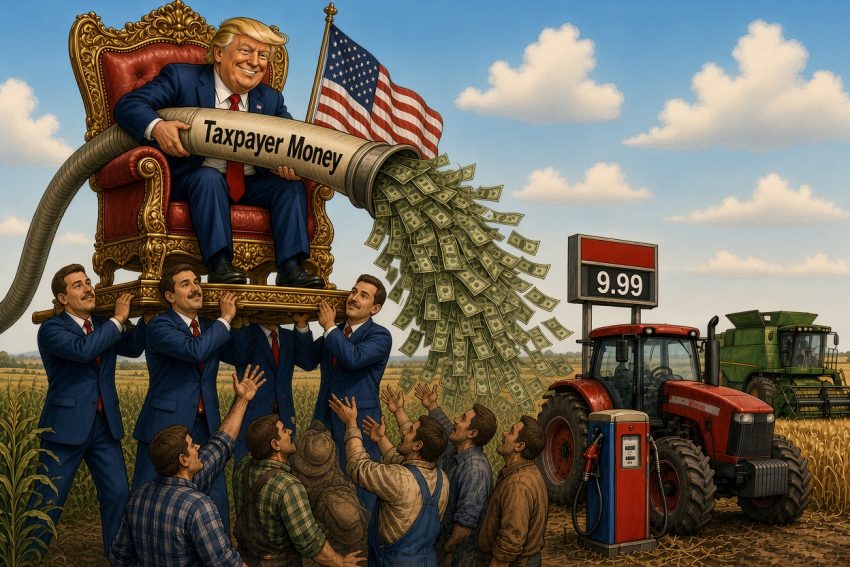
Farmers facing diesel prices near or above $6 a gallon this harvest season will take the money. They have little choice. Combines, tractors, irrigation pumps, and grain trucks do not run on good intentions. The Trump administration’s newly announced Harvest Fuel Relief program, an $8 billion package of one-time payments administered through the Farm Service Agency and funded by the Commodity Credit Corporation, will provide proportional support based on planted acres, cost-of-production estimates, and modeled losses for the 2026 crop year. Payment rates for Title I commodities are due in November. For many operations already squeezed by elevated input costs, this cash arrives as welcome breathing room.
It is still a band-aid on a wound this administration opened, though.
Diesel prices roughly doubled from last year’s levels, climbing past previous records. The primary driver has been the prolonged disruption of refined product flows out of the Middle East tied to the U.S.-Iran conflict that began earlier this year, including constraints through the Strait of Hormuz and damage to regional refining capacity. Secondary pressure has come from reduced Russian diesel exports linked to the war in Ukraine, which American tax dollars have been funding. U.S. refiners have been running near full capacity, limiting their ability to fill the gap. Earlier executive actions expanding access to tax-exempt red-dyed diesel and efforts to free up strategic stocks have not brought prices down meaningfully. The result is thousands of dollars in extra fuel costs per farm during peak harvest.
Direct payments will ease the immediate cash-flow hit for eligible producers. Yet the structure of the aid ensures the dollars largely cycle back to the same concentrated input suppliers that already extract high margins. Farmers buy fuel from the same distribution networks, fertilizer from the same handful of major producers, and equipment and parts from the same consolidated manufacturers and dealer systems. When government money temporarily boosts farmer purchasing power without addressing underlying supply constraints or market power, input prices stay elevated. The relief does not force competition. It subsidizes the ability to pay the inflated bill.
This outcome sits uneasily beside the administration’s own rhetoric on big ag. Officials have talked up antitrust scrutiny of meatpackers, fertilizer suppliers, seed companies, and equipment makers. Task forces, memorandums of understanding between the Justice Department and USDA, probes into price-fixing, right-to-repair pressure, and public criticism of “nasty monopolies” have all been part of the messaging. In practice, the pattern remains familiar: temporary taxpayer transfers that stabilize farm income while the concentrated firms upstream continue to capture value. The $8 billion program follows earlier bridge payments and functions less as structural reform than as another round of compensation for costs that competitive markets and stable energy supplies would have mitigated.
Producers on the ground understand the arithmetic. High diesel raises the cost of every field pass, every drying hour, every loaded truck to the elevator. Fertilizer and other energy-linked inputs move in tandem. A one-time check helps cover this year’s shortfall. It does not change the market structure that allows a few companies to maintain pricing power, nor does it resolve the geopolitical choices that tightened global diesel supplies. When the payments are spent, the same suppliers remain in position to price the next season’s inputs accordingly.
The program will be welcomed in farm country because harvest waits for no one and bills come due regardless of politics. That practical necessity does not erase the larger picture. This is compensatory spending for problems rooted in policy and market concentration, not a fix for either. Until diesel supply stabilizes and real competitive pressure is applied to the input side of agriculture, similar relief packages will keep arriving, and the money will keep flowing through to the same large players the administration once suggested it would confront.