

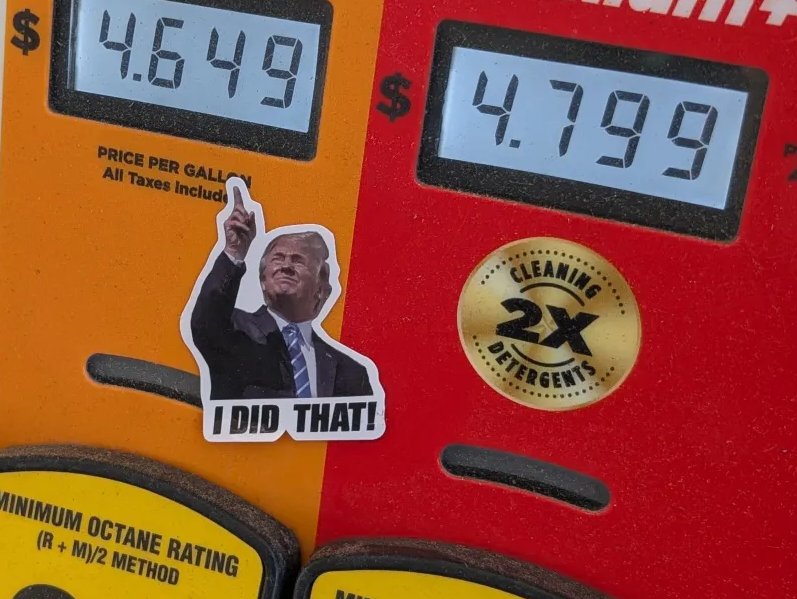
Across the heartland, diesel engines are burning through fuel that now costs a small fortune. One Ohio farmer, Fred Yoder, reports shelling out $1,500 a day just to run two tractors. Fertilizer prices have exploded. Potash that once went for $90 a ton now runs $670 to $700. Input costs are the worst many have seen since the 1980s farm crisis.
Yet in Washington, the message from the top is that this pain is minor. President Trump recently dismissed rising gas prices as “peanuts” compared to the threat of a nuclear Iran. “I appreciate everybody putting up with it for a little while,” he said. “I don’t even think about it.”
Trump on high gas prices: "This is peanuts. I appreciate everybody putting up with it for a little while. But I don't even think about. What I think about is you can't let Iran have a nuclear weapon." pic.twitter.com/XUVyNUpspm
— Aaron Rupar (@atrupar) May 19, 2026
Farmers are thinking about it every single day.
The Daily Reality vs. Beltway Priorities
Rural Americans are not abstractly debating geopolitics while filling up at the pump or staring at shrinking margins. High fuel prices do not stay isolated. They ripple through fertilizer production, transportation, machinery parts, groceries, and every corner of the farm economy. A new Farm Journal poll of nearly 1,000 producers captures the mood: deep frustration over a widening disconnect with Washington. Nearly three-quarters of farmers say elected officials simply do not understand what is happening on the land.
Global conflicts, tariffs, and policy decisions have sent input costs soaring. Farmers, as price-takers, absorb these hits while commodity prices lag and export markets face uncertainty. Young farmers are struggling. Dispersal sales are up. Rural hospitals and clinics close. The ag economy feels like it is on a knife’s edge. Yet the priorities coming out of D.C. often feel a million miles detached from the tractor seat.
Is a nuclear Iran is a serious long-term concern for US national security? North Korea, Pakistan, and other nations already possess nuclear weapons. U.S. intelligence has repeatedly assessed that Iran is not on the verge of a breakout. However, Netanyahu and his cronies in the US government disagreed.
For families who have not turned a consistent profit in years, who watch every extra dollar spent on diesel instead of equipment upgrades, family needs, or reinvestment, distant hypotheticals rank below immediate survival. Farmers do not have the luxury of treating crushing operational costs as an afterthought.
Elite Protection and Primary Purges
The frustration runs deeper than fuel prices. Recent moves in Washington have farmers and rural conservatives wondering whose side the system truly serves. The DOJ reached a settlement with the Trump family that effectively bars the IRS from auditing President Trump, his sons, and their businesses on past or future tax matters. While everyday Americans and small businesses face routine audits, the political elite secures special protection.
Simultaneously, heavy resources poured into unseating a populist Republican voice in Kentucky. Thomas Massie, long a thorn in the side of establishment foreign policy hawks and party leadership, faced challenge from a Trump-endorsed candidate, who received tens of millions of dollars from Israel-first billionaires. Trump and allies went all-in to replace Massie in the most expensive House primary in history, and they won.
In farm country, where skepticism of endless foreign entanglements, nation-building, and insider protections runs deep, this sends a message. Populist, independent-minded voices who question the consensus on spending, wars, and elite accountability are being targeted. The very movement that promised to drain the swamp now appears to be consolidating power in familiar ways. The Epstein class is fully entrenched.
The Heartland Disconnect
This is not abstract partisanship. It is a cultural and economic fracture. Rural America produces the food and fuel that powers the nation. Yet it feels increasingly invisible in policy rooms dominated by coastal interests, lobbyists, and global strategists. Polls show farmers prioritizing affordability, input costs, trade certainty, and rural healthcare. These are issues that hit balance sheets and communities directly.
When leaders downplay the very real pain at the pump as “peanuts,” it reinforces the sense that flyover country is an afterthought. It is tolerated for its votes and production but not truly heard. The 1980s scars still linger in many farm families: debt, foreclosures, lost operations. Repeating those pressures today, while Beltway insiders insulate themselves, breeds resentment that will not fade quietly.
AgroWars is not calling for retreat from strength abroad. But strength starts at home. It starts with a productive, profitable agriculture sector that is not sacrificed on the altar of distant priorities or protected-class politics. Farmers are not asking for handouts. They are asking for policies that recognize the ground truth: you cannot run a tractor on rhetoric, and you cannot feed a nation on disconnect.
The heat in farm country is rising. Washington would do well to listen before the next harvest.