

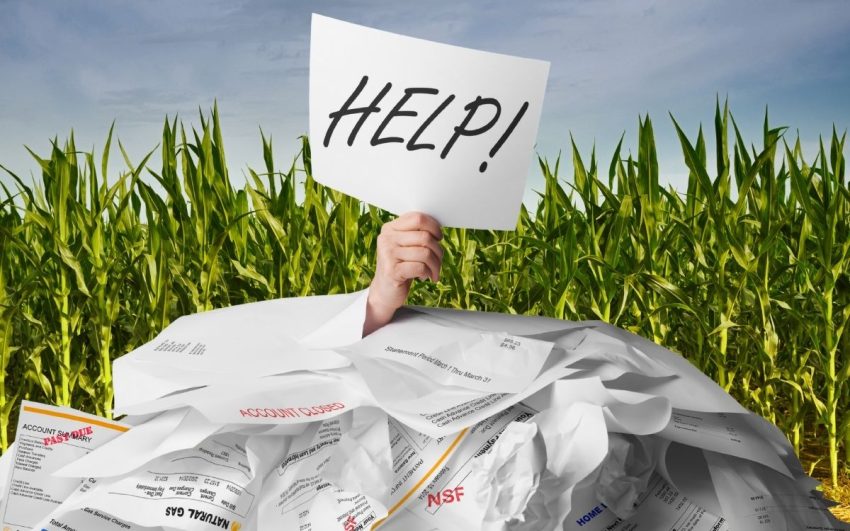
U.S. farmers are receiving record government payments at the same time farm debt climbs to new highs and key production costs, especially diesel, remain elevated. The combination leaves many operations under pressure even as Washington delivers the largest ARC and PLC payouts in the history of those programs.
USDA announced approximately $13.8 billion in gross ARC and PLC payments for the 2025 crop year, the biggest annual total since the programs began under the 2014 Farm Bill. After payment limits and the required 5.7 percent sequestration cut, actual disbursements will be lower, with some estimates putting the net closer to $13.1 billion. Total federal farm payments for 2026 are projected at roughly $47.4 billion, nearly $19.5 billion higher than the prior year. These funds provide important liquidity for eligible commodity producers, yet they are tied to revenue and price conditions rather than direct reimbursement for rising operating costs.
Meanwhile, USDA’s Economic Research Service forecasts total farm sector debt at a record $605.1 billion in 2026, up 4.6 percent from 2025, or 1.5 percent after inflation adjustment. Real estate debt is projected at $399 billion and non-real estate debt at $206.1 billion. Debt is expected to grow faster than assets and equity, pushing the debt-to-asset ratio slightly higher from 13.34 percent to 13.54 percent. Working capital is forecast to rise 3.5 percent after a sharp drop the previous year, but other liquidity measures point to tighter conditions. Official figures may also understate the full picture, as increased borrowing from suppliers, cooperatives, equipment makers, and other nontraditional lenders is harder for USDA to track comprehensively.
Production expenses are climbing as well. USDA projects total agricultural production expenses of $492.8 billion in 2026, an increase of $21.2 billion or 4.5 percent. Fuel and oil costs alone are expected to jump from $16.8 billion in 2025 to $21.6 billion in 2026, a 29 percent rise of about $4.8 billion. Fertilizer, marketing, storage, and transportation add further pressure.
Diesel remains a particular pain point. Tight global distillate supplies are keeping U.S. inventories below normal. The Energy Information Administration expects fourth-quarter distillate inventories to be about 11 percent below the five-year average. Strong U.S. production and high refinery utilization have been offset by increased exports, especially to Europe, and lower global refining activity. The result is sustained pressure on retail diesel prices through harvest and into winter. For farmers this means higher costs for fieldwork, harvest, trucking, and related operations, with knock-on effects for freight rates.
State-level comparisons highlight uneven relief. California faces estimated agricultural diesel costs of $1.19 billion against only $242.6 million in ARC/PLC payments. Texas, Iowa, Illinois, and other major commodity states show closer alignment or even net positives on paper for those programs, but specialty crop regions and high-fuel operations absorb more of the hit. Per-acre fuel cost increases vary widely by crop, with specialty crops often facing steeper burdens than corn or soybeans.
Diesel prices could face additional upward pressure depending on policy direction. Recent efforts to ease supply constraints, including deals involving Russian diesel and temporary measures on dyed diesel, have drawn skepticism from analysts who question their scale and near-term impact on U.S. pump prices. Any further trade or sanctions actions that restrict global distillate flows risk compounding the tightness already baked into inventories.
On the input cost front, federal agencies have stepped up rhetoric and coordination on competition. The Justice Department and USDA expanded their partnership through a new memorandum of understanding focused on agricultural inputs including fertilizer, seed, fuel, and pesticides. The FTC and DOJ have ongoing investigations into fertilizer markets, with public hearings and signals of forthcoming actions. USDA officials have highlighted concerns about market concentration and barriers to new competitors. Yet for producers facing immediate cash-flow squeezes, these steps still amount largely to investigation and statements rather than rapid, measurable relief at the farm gate.
The net result is a safety net delivering historic sums while the underlying cost structure and debt load continue to expand. Payments help eligible operations bridge gaps, but they do not erase higher fuel bills, elevated fertilizer and other inputs, or the rising leverage across the sector. As harvest progresses and winter approaches, the gap between record support and persistent cost inflation will test how far federal checks can stretch against the realities of the farm balance sheet.