

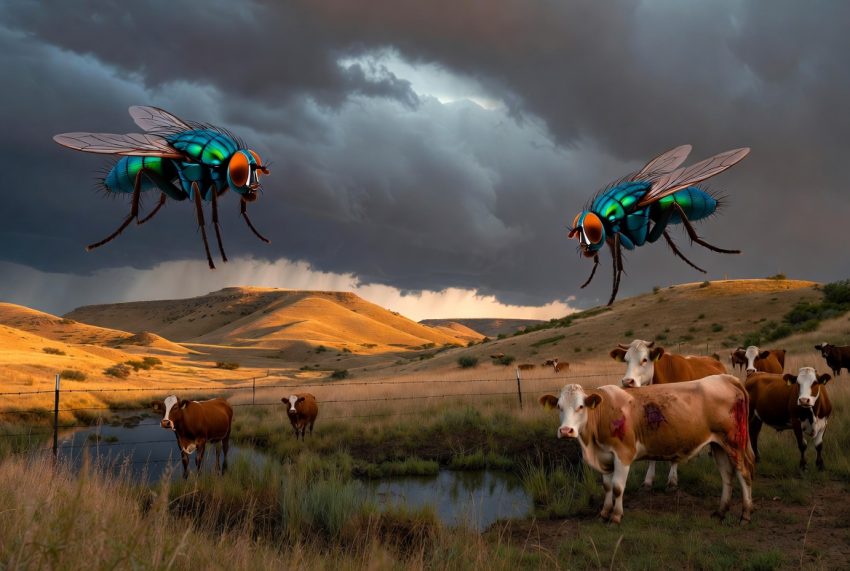
The United States has seen its first confirmed cases of New World screwworm in decades, with the outbreak spreading faster than initial reports suggested. Since the first detection on June 3, 2026, in a calf in Zavala County, Texas, USDA APHIS has confirmed at least five cases by June 8-9. These include additional calves in Zavala and La Salle Counties, a goat in Gillespie County, Texas, and a dog in Lea County, New Mexico.
The geographic jump, including a case over 400 miles from the initial South Texas site and across state lines within days, has heightened worries among producers despite the relatively low total case count so far.
Biology and Immediate Threat
New World screwworm flies lay eggs in open wounds or body openings of warm-blooded animals. Larvae hatch and feed on living tissue, creating painful, expanding wounds that can cause severe infection, debilitation, or death without prompt treatment. Livestock, wildlife, pets, and rarely humans are at risk.
Producers must inspect animals daily, especially newborns and those with wounds, and report any signs of maggots or distress immediately. Approved treatments and wound care can save individual animals when applied quickly.
USDA Response: Actions Taken Amid Questions on Preparedness
USDA APHIS is coordinating with state agencies on quarantines, movement controls, enhanced surveillance, and sterile insect releases. A 20-kilometer infested zone includes treatment and inspection requirements. Ground sterile fly releases supplement ongoing border efforts, while a new domestic production facility at Moore Air Base in Texas is under construction to increase capacity.
Officials highlight years of cross-border work in Mexico and Central America, import restrictions, and preparedness planning as reasons for measured optimism. They point to the proven sterile insect technique that eradicated the pest from the US in 1966.
However, the rapid multi-county and interstate spread has drawn criticism. USDA and partners had tracked the pest’s northward advance through Mexico since 2023 and knew models predicted a 2025-2026 US entry. Despite investments in sterile fly production and a response playbook, the fly reached US soil.
Key concerns include:
- Current sterile fly production capacity remains limited compared to what full-scale eradication may require. The new Texas facility aims for hundreds of millions weekly but is not yet operational at full scale.
- Questions persist about whether earlier suppression efforts in Mexico, border controls, and domestic surveillance resources were sufficient to prevent entry.
- Today’s larger livestock populations, extensive animal transport networks, potential wildlife reservoirs, and changing climate conditions present greater challenges than the original 1960s campaign.
Worst-Case Scenario for American Agriculture
Should containment fail and the fly establish breeding populations across the southern US or farther, impacts could be substantial. Adjusted estimates from past outbreaks suggest annual losses to Texas livestock alone in the billions, with broader national economic effects reaching tens of billions through mortality, reduced productivity, veterinary costs, quarantines, and trade disruptions.
Widespread establishment would likely trigger extensive interstate movement restrictions, international trade barriers, and sustained management costs for years. Wildlife and companion animal effects would complicate efforts further. Reversal of the decades-long benefits of eradication could strain cattle, dairy, sheep, goat, and related sectors significantly.
The food supply remains safe. Screwworms do not infest processed meat or crops, and federal inspections protect commerce.
Outlook
While the sterile insect technique offers a proven tool and early actions have mobilized resources, the speed of new detections shows that containment is not yet assured. Success will depend on rapid scaling of production, highly effective surveillance and tracing, producer vigilance, and sustained cross-border cooperation. If fertile populations take hold, the response could shift from quick eradication to prolonged, expensive management.
Ranchers should maintain strict biosecurity, treat wounds promptly, and monitor official channels like Screwworm.gov for updates. This remains a fast-moving situation where the coming weeks of data will determine whether the incursion is contained or becomes a longer-term threat to US agriculture.