

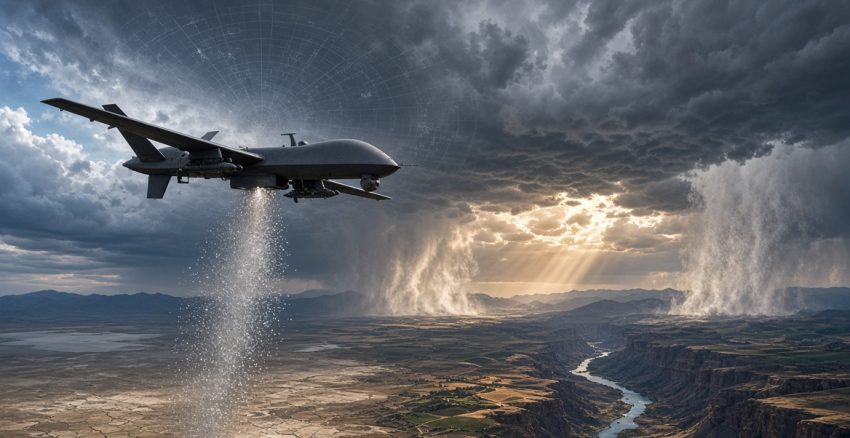
In late August 2026, Rainmaker Technology Corporation published a validation report on drone-based glaciogenic cloud seeding operations over Alaska’s Kenai Peninsula. CEO Augustus Doricko highlighted the results on X: roughly 19 million gallons of net-new precipitation generated in about three hours across seven coordinated missions using two of the company’s Elijah drones. The company identified seven distinct radar seeding signatures and estimated a mean of 57.6 acre-feet of additional water (range 45–65 acre-feet) using quantitative precipitation estimation methods adapted from prior National Center for Atmospheric Research work.
Rainmaker just produced ~19M gallons of water in Alaska via next-gen cloud seeding over 3 hours of operations.
We are the first company to provably produce precipitation in Alaska. As promised, we’ve linked our white paper and relevant data.
In the future, Rainmaker will…
— Augustus Doricko (@ADoricko) August 25, 2026
Doricko framed the Alaska results as immediate proof of concept for larger ambitions. “Immediately, this demonstration shows how Rainmaker will add new water to the Colorado River and Great Salt Lake in the coming months,” he wrote. The company has previously claimed validated production of over 140 million gallons in operations across Utah, Oregon, and Idaho, and it already holds contracts with Western states and water authorities aimed at boosting snowpack and streamflow. Its materials explicitly reference supporting restoration of the Great Salt Lake and work in the Colorado River Basin.
If Rainmaker’s latest measurements hold up under broader scrutiny, the technology has crossed a threshold from long-debated weather modification into something more measurable and scalable. Cloud seeding itself is not new. It has been practiced in the United States since the 1940s, typically by dispersing silver iodide into supercooled clouds to encourage ice crystal formation and subsequent precipitation. Traditional programs have claimed modest increases, often in the 5–15% range under favorable conditions. Rainmaker’s innovation centers on drones for precise delivery, real-time radar tracking of “seeding signatures,” and claims of unambiguous physical validation that earlier operators struggled to provide.
That claimed effectiveness raises the questions the public has been asking since the deadly July 2025 floods in central Texas. Rainmaker conducted a brief seeding operation on July 2 over south-central Texas, roughly 100–150 miles from the worst-hit areas in the Hill Country. Two clouds were seeded; they dissipated within hours. Catastrophic flooding from remnants of a tropical system struck days later, killing more than 130 people. Conspiracy claims linked the company to the disaster. Multiple meteorologists, atmospheric scientists, and fact-checkers rejected any causal connection. Cloud seeding cannot create storms from nothing, cannot generate the energy or moisture of a large-scale weather system, and typically enhances existing precipitation by limited percentages at most. The seeded material does not remain aloft for days across hundreds of miles in the quantities needed.
Yet the logic of the skepticism cuts both ways. If the technology is powerful enough to produce tens of millions of gallons in a few hours under suitable conditions, as Rainmaker now asserts with radar data, why is it considered physically impossible for poorly timed or poorly located operations to contribute even marginally to extreme local rainfall? Official responses emphasized the limited scale and the natural drivers of the Texas event. Still, the gap between “modest enhancement under ideal conditions” and “provable production of 19 million gallons in three hours” invites scrutiny about edge cases, operational judgment, and the difference between controlled research flights and commercial work near moisture-laden systems. Transparency about exact locations, timing, suspension criteria, and independent verification remains essential precisely because the stakes involve both drought relief and flood risk.
Effectiveness also forces the broader question of control and intent. Geoengineering technologies that alter precipitation, temperature, or atmospheric composition sit on a spectrum. Cloud seeding is localized and targets existing clouds; solar radiation management or other planetary-scale interventions are different in kind. Rainmaker itself distinguishes the two. History, however, shows governments and militaries have explored weather modification for strategic purposes. Once the capacity to nudge precipitation exists at measurable scale, the possibility of use for competitive advantage, denial of water to adversaries, or domestic political leverage cannot be dismissed as pure fantasy. Regulation, international norms, and verification lag far behind the technology’s commercial momentum. States have already begun responding with bans or restrictions in places such as Tennessee and Florida, while others expand programs.
Equity concerns follow directly. Cloud seeding does not create water molecules; it influences where and when existing atmospheric moisture falls. Studies of “extra-area” or downwind effects have produced mixed findings. Some analyses of operational programs found no evidence of systematic depletion and even suggested modest positive effects farther downwind. Others note that precipitation efficiency is increased in the target area, which can leave less moisture for regions farther along the storm track. In water-scarce basins, the practical result can look like prioritization: the entity that pays for the drones and flares receives the incremental snowpack or rainfall.
Rainmaker’s model relies on contracts with states, municipalities, and water authorities. Wealthier agricultural regions, ski areas, or urban utilities can more readily fund operations. Poorer neighboring districts may face relative disadvantage if the same atmospheric moisture is harvested upstream. Over time, this risks a “pay-to-play” system in which precipitation enhancement becomes another commodity layered onto existing water markets and rights. The Colorado River and Great Salt Lake already illustrate zero-sum pressures among users. Adding intentional atmospheric intervention intensifies the need for transparent allocation rules and regional governance rather than purely private or state-level deals.
We have always lived at the mercy of natural weather patterns. Human activity has long influenced local climate through land use, irrigation, and urban heat, but deliberate, measurable precipitation enhancement represents a different degree of agency. Rainmaker and similar firms argue they are restoring abundance to ecosystems and farms under stress, independent of larger debates over long-term climate trends. The technology’s success does not require acceptance of any particular climate narrative; drought and declining snowpack are observable facts in the West regardless of attribution.
When then-Congresswoman Marjorie Taylor Greene and others raised concerns about government or corporate weather control, the response was often ridicule. The same technology now being marketed to lawmakers and water managers as a practical tool for the Colorado River and Great Salt Lake was previously treated as fringe when critics warned of its implications. The Alaska white paper and Rainmaker’s public claims close that gap. The capacity exists. The commercial incentives exist. The political interest exists.
Where this leads depends on choices still ahead: independent scientific validation of claimed yields, clear rules on when and where seeding is permitted, cross-border and inter-state agreements on atmospheric moisture, liability frameworks for unintended consequences, and public accountability for who benefits. Weather modification is no longer theoretical. The question is whether society will treat it as another infrastructure technology requiring oversight, or allow it to expand primarily under market and political pressures. The water will fall somewhere. The decisions about where, and for whose benefit, are increasingly human ones.
3 web pages