

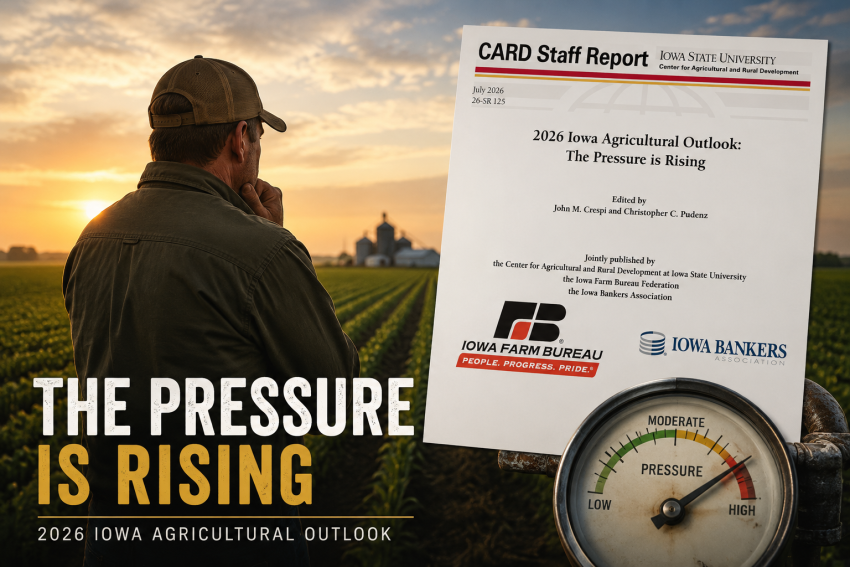
Iowa’s agricultural sector, a cornerstone of the state’s economy, faces significant headwinds according to a new report from Iowa State University, the Iowa Farm Bureau Federation, and the Iowa Bankers Association. Titled “2026 Iowa Agricultural Outlook: The Pressure is Rising,” the study details a multi-year downturn that has seen net farm income fall sharply while costs continue to climb.
The Core Numbers: A 53 Percent Income Decline
The report shows Iowa farm income tumbled 53 percent from 2022 to 2024. This steep drop stems from a combination of record-high input costs, depressed corn and soybean prices, and ongoing trade uncertainties. Experts warn the pressure will likely persist through 2027, even as federal assistance provides a temporary buffer.
Christopher Pudenz, economist with the Iowa Farm Bureau, highlighted that this marks the third consecutive year of crop costs outpacing revenues. Record and near-record crop production has pushed prices downward, squeezing margins for producers already battling elevated expenses.
Financial Vulnerability on the Rise
One of the most concerning findings involves farm financial health. In December 2025, 19 percent of mid- and large-size Iowa farms were classified as financially vulnerable. This figure more than doubled from 7.7 percent in 2022. While still below levels seen during the 2015-2019 downturn, the trend signals growing stress.
Chapter 12 farm bankruptcies have risen nationally and in Iowa. Lending data also shows increased credit demand and slower loan repayments. ISU economist Chad Hart noted similarities to past cycles but emphasized key differences from the 1980s farm crisis, including relatively low debt-to-asset ratios and steadier land values.
Cost Pressures and Input Inflation
Iowa corn growers have seen supply costs rise 37 percent since 2021, with soybean producers facing a 36 percent increase. Major drivers include machinery expenses, seed, chemicals, and fertilizer. Iowa Farm Bureau President Brent Johnson pointed to potential antitrust concerns contributing to these artificially high costs.
Hart advised farmers to focus on controllable factors by tightening budgets, maximizing returns on inputs, and revisiting cost-management practices that helped during the previous decade’s challenges.
Land Values Provide Some Stability, But Risks Remain
Farmland values have offered a buffer, inching up less than 1 percent last year to an average of $11,549 per acre. However, 40 percent of survey participants expect values to decline over the next year. Further softening could strain operations relying on land equity for operating credit.
Broader Economic Ripple Effects
Agriculture and related industries contribute about $51.5 billion annually to Iowa’s economy, representing roughly 19-20 percent of state GDP. Every dollar earned in these sectors supports an additional $1.50 in broader economic activity. A prolonged downturn therefore threatens rural communities, jobs, and the state’s overall economic health.
Livestock sectors provide a relative bright spot, performing generally well despite challenges like avian influenza and softer demand in some areas. They also offer entry points for new producers.
Federal Aid Offers Relief, Not a Cure
Substantial federal support, including around $30 billion last year and $45 billion this year for U.S. farmers, has helped many operations stay afloat. Proposed additional aid has been discussed, but leaders like Johnson stress it lengthens the runway without solving underlying issues of demand, prices, and costs. Increased domestic and global market access remains critical.
What Farmers and Stakeholders Should Watch
The report underscores the need for prudence: control costs, manage debt carefully, and avoid over-reaction to uncertainty. Hart and others encouraged looking to proven strategies from past downturns while leveraging modern tools developed since the 1980s.
For Iowa’s farm economy, the message from the ISU study is clear. The pressure is rising, but proactive management and a focus on fundamentals can help weather the storm until markets recover. The coming years will test resilience across the sector and the rural communities it sustains.