

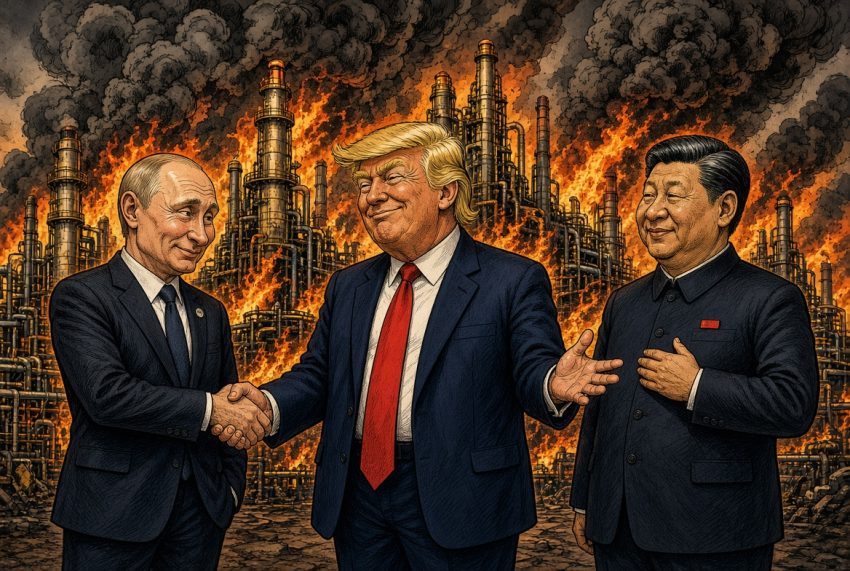
American farmers, truckers, and rural communities live and die by the price and availability of diesel. Every gallon that becomes more expensive or harder to get hits fuel tanks, fertilizer production, grain hauling, and the thin margins that keep family operations alive. Against that backdrop, reports of high-level discussions aimed at securing Russian diesel or related energy flows while the United States continues large-scale military and financial support for Ukraine create an obvious tension.
The United States has spent tens of billions of dollars on weapons, training, intelligence, and direct assistance to Ukraine. That support is framed as defending a partner against Russian aggression and degrading Russian military capacity. At the same time, any arrangement that eases pressure on diesel supplies or energy markets by engaging Russia is presented as relief for American agriculture and transportation. The two policies pull in opposite directions: one seeks to impose costs on Russia; the other contemplates commercial or strategic engagement that could lower those costs for U.S. users of diesel.
A parallel pattern appears elsewhere. Trade and diplomatic outreach with China proceeds even as Beijing’s material support for Iran contributes to the arsenal used by Iranian-backed groups against U.S. forces and partners in the Middle East. Soldiers and contractors on bases face drones, rockets, and other munitions while officials shake hands and negotiate market access or investment terms. The people who absorb the physical risk are not the ones signing the deals.
This is not a new observation. War has long functioned as a profitable enterprise for those who supply it. Prolonged conflict depletes stockpiles of artillery shells, missiles, air-defense interceptors, and other high-end munitions. Replacement orders flow to a concentrated set of defense contractors. Stock prices, production lines, and political influence rise with sustained demand. The longer the fighting continues, the larger the contracts. Rural America, meanwhile, absorbs higher input costs, tighter credit, and the human cost when its sons and daughters serve in the conflicts those munitions support.
None of this requires discussion of secret cabals, though they certainly do exist. Public budgets, contracting data, and the revolving door between the Pentagon, Congress, and industry already show the incentives. Policy that simultaneously funds the depletion of Russian forces and explores ways to stabilize energy flows that benefit Russian revenue streams simply makes the contradiction visible. The same is true when commercial engagement with China continues alongside Chinese assistance to actors targeting American personnel.
Farmers and truckers do not set these priorities. They pay the diesel bill, the insurance premiums, and the opportunity costs when markets swing on geopolitical risk. The people who authorize the weapons packages and the people who negotiate the energy or trade understandings operate in different rooms, often with different incentives. When those incentives align around extended conflict and continued high demand for munitions, the racket is not subtle. It is simply the ordinary business of war conducted at scale.
Rural America has every reason to notice the mismatch. Diesel is not an abstract commodity; it is the difference between planting and parking the tractor, between a profitable haul and a loss. Any policy that claims to help American producers while simultaneously underwriting the very conflicts that keep energy markets volatile and defense budgets elevated deserves scrutiny on those terms alone. The soldiers who come home maimed or in boxes, and the communities that bury them, already know the price. The rest of the country should stop pretending the ledger only runs one way.