

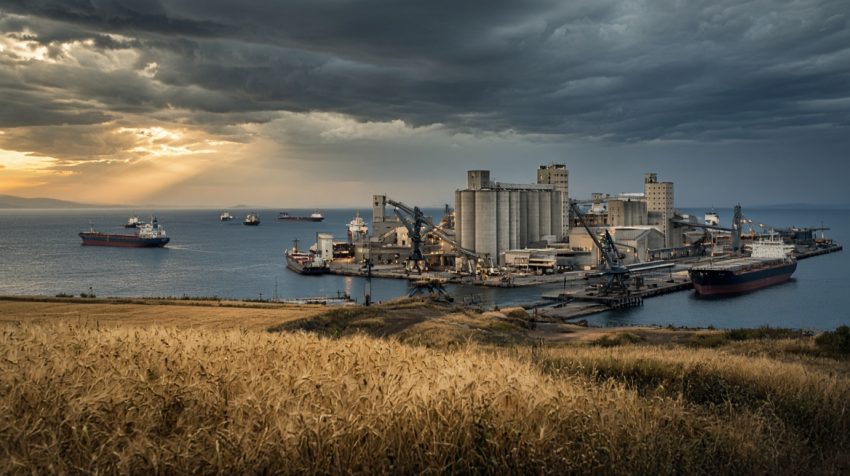
In the summer of 2026, the Russia-Ukraine war has escalated into a direct assault on agricultural infrastructure and the Black Sea shipping lanes that move a critical share of the world’s grain. Russian missile and drone strikes have repeatedly hit Ukrainian ports around Odesa, vessels carrying grain, railways, and energy facilities. Ukrainian forces have responded with attacks on Russian grain terminals at Novorossiysk and Taman, as well as vessels in the Sea of Azov and Kerch Strait. The result is a sharp contraction in exports from two of the planet’s leading suppliers of wheat, corn, barley, and sunflower oil at the peak of the harvest season.
Ukraine normally ships more than 90 percent of its agricultural exports through Black Sea deepwater ports. In the first two weeks of August 2026, grain exports fell by roughly 75 percent compared with the same period a year earlier. Monthly volumes from Odesa-area ports risk dropping by as much as a third, with shipowners refusing to call amid strikes that have killed crew members and damaged terminals. Carryover stocks of corn and wheat are projected to climb toward 9 million tons or higher because grain cannot leave the country fast enough. Storage capacity is already under pressure as the new harvest arrives.
Russia, the world’s top wheat exporter, faces parallel disruptions. Strikes have halted operations at major terminals in Novorossiysk and damaged facilities at Taman. Navigation restrictions through the Kerch Strait have cut shipments from Azov Sea ports that handle a significant share of Russian grain. July wheat exports were estimated around 1.5 million metric tons, well below recent averages, with August volumes also expected to decline sharply. Russia’s grain exporters’ union has warned that sustained attacks could produce a shortfall of 30 to 35 million metric tons of wheat, roughly 15 percent of global trade, that other suppliers cannot fully replace.
Together, Russia and Ukraine account for a substantial portion of internationally traded wheat, corn, barley, and sunflower products. The Black Sea corridor has become a chokepoint. Higher freight rates, insurance costs, and outright refusals by shipowners are already pushing global prices higher. Wheat prices have risen about 25 percent from early 2026 levels in response to these tensions combined with drought elsewhere. Officials in Ukraine have cautioned that continued disruption could lift global food prices by 25 to 30 percent, echoing the shocks of 2022.
Worldwide Agricultural Consequences
The immediate effect is tighter supplies and greater price volatility for importing nations, particularly in the Middle East, North Africa, and parts of Asia and sub-Saharan Africa that rely heavily on Black Sea grain. Higher prices raise the cost of bread, feed, and cooking oil for households already strained by earlier inflation. Domestic prices in Ukraine have collapsed below production costs for some farmers because grain cannot move, threatening next season’s planting and long-term productive capacity. Landmines, damaged irrigation (notably after the earlier destruction of the Kakhovka Reservoir), and labor shortages compound the production challenges.
Russia’s own agricultural sector is not immune. Labor losses and export constraints are limiting its ability to capitalize fully on global demand even as it seeks new markets. The dual-sided nature of the current attacks distinguishes this phase from earlier periods when Ukrainian exports were the primary target. Both sides are now degrading the infrastructure that feeds much of the world.
The Strait of Hormuz Overlay and Famine Risk
These grain disruptions arrive against the backdrop of a prolonged choke on the Strait of Hormuz that began in early 2026. The strait normally carries a large share of seaborne fertilizer trade, including roughly 30 percent or more of globally traded urea and significant volumes of other nutrients and feedstocks, along with oil and diesel-related products. Shipping traffic has collapsed, fertilizer prices spiked (urea roughly doubled at peaks before partial easing), and diesel costs have risen sharply in key agricultural regions.
Fertilizer affordability is strained for farmers worldwide. Reduced application rates lower yields in subsequent seasons. Diesel powers tractors, harvesters, irrigation pumps, and the trucks that move crops. Higher energy costs raise the entire cost structure of food production and distribution. The combination of constrained grain exports from the Black Sea and constrained inputs from the Persian Gulf creates a dual supply shock: less grain moving now and potentially less grain produced later.
Analysts and agencies have warned that sustained disruption raises the risk of acute hunger in import-dependent, low-income countries. Russian grain lobby statements have explicitly flagged possible famine conditions in parts of the Middle East and Africa if Black Sea corridors close. The UN Food and Agriculture Organization and others have described the Hormuz situation as a systemic agrifood shock that could trigger severe price crises within months if unresolved. Escalation that further closes Black Sea routes while Hormuz remains restricted would compound these pressures. Global stocks and alternative suppliers (United States, EU, Australia, Argentina, Canada) can absorb some shortfalls, but not indefinitely or without price spikes that hit the poorest hardest. Full-scale famine is not inevitable if diplomacy or alternative logistics expand, yet the margin for error has narrowed considerably.
Implications for American Farmers
For U.S. producers the picture is mixed but largely supportive of higher commodity prices in the short to medium term. Reduced Black Sea supplies increase demand for American wheat and corn in certain markets, particularly those that can shift origins. Futures prices have already responded to the uncertainty, with hard red winter wheat trading near multi-year highs at times. Export opportunities could expand if Ukrainian and Russian volumes stay constrained.
At the same time, American farmers face elevated input costs. Diesel prices in Midwest states reached record levels earlier in 2026 as the Hormuz crisis restricted fuel flows. Fertilizer costs remain higher than pre-crisis levels even after some moderation. These expenses squeeze margins, especially for corn and other nutrient-intensive crops, at a moment when some grain prices have not risen enough to fully offset them. Livestock and poultry operations confront higher feed costs if corn and wheat prices climb further. Drought in parts of the U.S. Plains has already reduced wheat production forecasts, limiting the ability of domestic supply to buffer global tightness.
American agriculture is more resilient than that of many importing nations thanks to scale, infrastructure, and domestic fertilizer production capacity. Yet higher global prices feed through to consumer food costs at home, and volatility complicates planting, marketing, and risk management decisions. U.S. farmers stand to gain from export demand if Black Sea flows remain restricted, but they also absorb the higher diesel and fertilizer bills created by the parallel Hormuz disruption. Prolonged dual crises would amplify both the price support and the cost pressures.
The attacks on farms, ports, and vessels in the Russia-Ukraine war are no longer a distant geopolitical story. They directly threaten the movement of calories that sustain hundreds of millions of people. Layered on top of fertilizer and diesel constraints from the Strait of Hormuz, the situation has raised legitimate concerns about food security and the potential for deeper shortages if the conflict expands further. Markets, policymakers, and producers must navigate a landscape in which two critical agricultural chokepoints are simultaneously under stress. The outcome will shape prices, planting decisions, and hunger levels well beyond the Black Sea.