

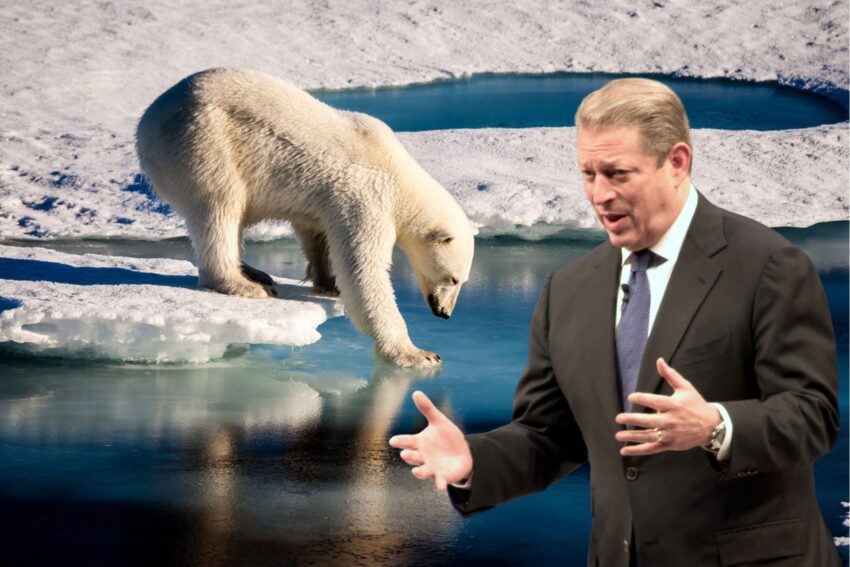
Al Gore, the central figure who turned global warming into a massive industry, now warns of the opposite threat. At a recent Hollywood event marking the 20th anniversary of his film “An Inconvenient Truth,” Gore told the audience that a collapse of the Gulf Stream could occur within 25 years, potentially triggering a new ice age similar to the scenario in the disaster movie “The Day After Tomorrow.”
This marks a notable pivot. Gore built his influence on predictions of rising temperatures, melting ice caps, and catastrophic flooding that demanded urgent control over energy, industry, and national economies. Two decades later, he highlights risks from Greenland ice melt disrupting ocean currents and causing regional cooling.
Shifting Doomsday Narratives
Gore’s earlier forecasts included a high probability of a nearly ice-free Arctic summer within five to seven years from 2009, a timeline that passed without that outcome. Visuals in “An Inconvenient Truth” suggested dramatic sea level rise that has not materialized at the predicted pace. The new warning reframes warming as a trigger for cooling, yet the core message stays consistent: impending catastrophe requires sweeping societal changes.
From an agricultural perspective, the distinction matters greatly. Milder temperatures and higher carbon dioxide levels have supported longer growing seasons, planetary greening, and record crop yields that sustain growing populations. A genuine global freeze or new ice age would shorten growing seasons, disrupt weather patterns, and pose far greater risks to food production than moderate warming.
Fear Mongering for Control
Despite the flip in headline threat, the proposed solutions remain the same: expanded government oversight of industries, restrictions on ‘fossil fuels’, carbon regulations, and centralized planning. This flexibility reveals how climate alarm serves as a tool for influence rather than a fixed scientific conclusion.
Questioning the dominant narrative has often led to silencing rather than open debate, much like early challenges to certain COVID policies and vaccine claims. When billions in funding, political power, and institutional prestige depend on a particular view, incentives favor exaggeration over rigorous scrutiny. True science thrives on falsification, replication, and dissenting voices, not enforced consensus or labels of heresy.
Practical Lessons for Agriculture
For the farming sector, policies driven by climate fear have already increased costs through biofuel mandates, fertilizer limits, and emission rules that constrain output. Resilience against natural climate variability, including potential cooler periods, requires practical measures: advanced crop breeding, improved irrigation, soil management, and affordable energy for production.
Earth’s climate has varied for millennia through orbital cycles, solar changes, and other natural factors. Modern warming followed the Little Ice Age, yet the narrative often attributes every shift primarily to human activity while demanding obedience.
Gore’s evolution from warming prophet to ice age sentinel exposes the mutable nature of these forecasts. Whether the proclaimed danger is heat or cold, the push for greater control over people, industries, and governments persists. Agriculture benefits most from evidence-based adaptation, technological progress, and open markets rather than fear-driven mandates. Skepticism toward bought-and-paid-for science, backed by thorough vetting instead of censorship, remains vital to avoid repeated policy missteps.