

The UK has provided a clear blueprint for manufacturing a food shortage. What looks like a sudden crisis blamed on weather and geopolitics is the predictable result of years of deliberate policy choices that made farming unprofitable, then paid producers to abandon it.
British media now urge citizens to stockpile canned goods. Officials point to climate pressures and hostile states. These talking points mirror earlier tabletop exercises that called for tighter global control of food systems. The real drivers sit much closer to home, as detailed in a recent article on the Unshadowed Substack.

Start with inheritance tax. For generations, Agricultural Property Relief protected family farms so land and equipment could pass intact from one generation to the next. That protection ended on 6 April 2026. Relief is now capped at £2.5 million. Anything above that faces an effective 20 percent tax. Farmland and machinery already operate on thin margins. The tax forces cash-poor but asset-rich operations to sell simply to settle the bill. Experienced farmers leave the land. The policy does not ban production. It just makes continuity impossible.
Next came the withdrawal of support. After the Second World War, payments encouraged farmers to grow food and secure national supply. Under the EU, this became the Basic Payment Scheme, averaging tens of thousands of pounds a year for many holdings. After Brexit the scheme was wound down. Delinked payments for 2026 were capped at £600. The replacement Sustainable Farming Incentive ran out of money and closed applications in 2025 with no warning. Farmers who had spent months and money preparing bids were left with empty budgets and no alternative income. A system that once underpinned food security was dismantled.
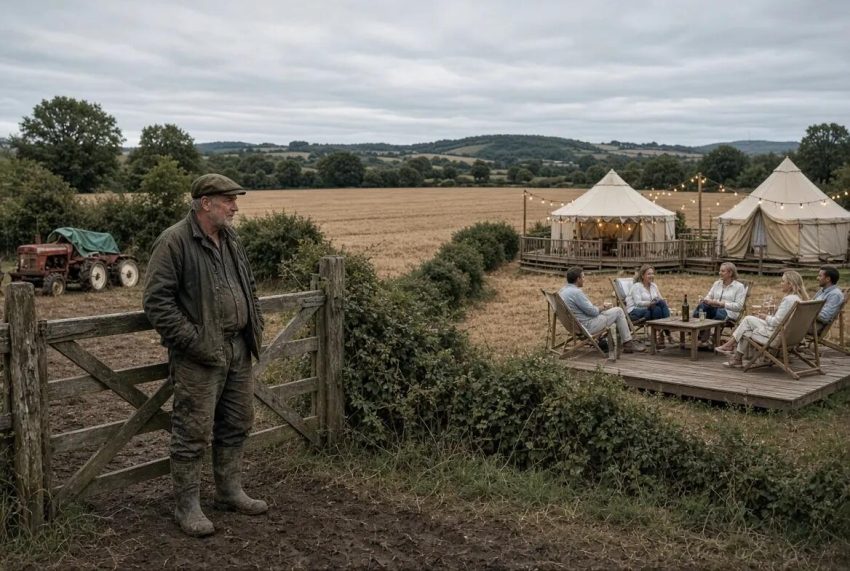
Policy then went further. A new land-use framework set an explicit target: more than 10 percent of England’s farmland should leave food production by 2050. Grassland for livestock faces the steepest cuts. Incentives steer remaining land toward rewilding, glamping sites, or solar arrays. One well-known estate that once grew cereals and ran hundreds of dairy cows and sheep now advertises yurts for rent. Food production was deliberately ranked below other priorities linked to international conservation goals.
With yields at historic lows, the same officials who designed these changes now warn of shortages. The National Farmers’ Union notes that many producers lack the cash to plant next season. The official narrative shifts to climate and external threats. The solution they offer is to accelerate gene-edited crops and have high-tech surveillance of fields. Traditional farming was never outlawed. It was simply rendered uneconomic, then replaced by payments for not farming, and the resulting gap is sold as an emergency.
The pattern is not unique to Britain. The Netherlands has used nitrogen rules and buyouts to remove livestock farms. German farmer groups report similar cash shortages ahead of planting. In each case the mechanism is the same: regulation and fiscal pressure first, then incentives to exit production, followed by crisis messaging that justifies further central control.
The lesson is straightforward. Food security does not collapse overnight from weather alone. It erodes when governments tax productive assets into sale, withdraw the supports that kept thin-margin operations alive, and then pay landowners to stop growing food. Once the capacity is gone, the shortage is real and the political response expands the very technocratic systems that helped create the problem.
Communities that value reliable local supply should treat the British sequence as a warning, not a model. Protect inheritance pathways for working farms. Maintain predictable support that rewards actual production rather than its absence. Resist land-use plans that treat food as optional. The alternative is to watch the same steps unfold and then accept the official explanation that the crisis was always inevitable.