

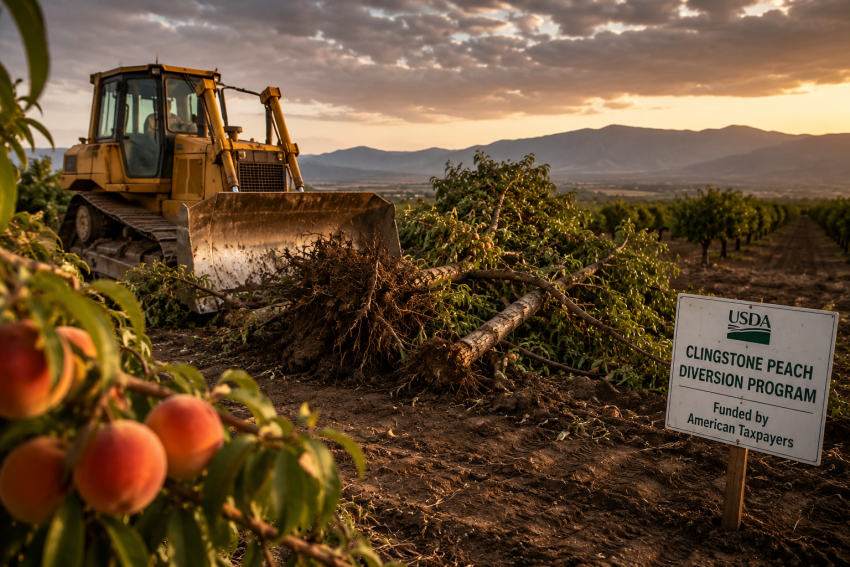
Few images capture the contradictions of modern agriculture quite like healthy fruit trees being ripped from the ground while taxpayers help pay the bill.
That is exactly what is happening in California this year. Through its Clingstone Peach Diversion Program, the USDA has committed up to $9 million to remove roughly 420,000 clingstone peach trees across about 3,000 acres of orchards in the Central Valley.
The trees were not diseased, damaged by drought, or wiped out by insects. They simply lost their market.
The crisis began after Del Monte Foods filed for Chapter 11 bankruptcy in 2025 and canceled long-term contracts with approximately 70 family-owned growers. Unlike the peaches sold fresh in grocery stores, clingstone peaches are bred almost exclusively for canning. Without processors willing to buy the crop, growers were left with orchards that still required irrigation, pruning, pest control, and labor but generated little or no income.
Faced with mounting losses, many accepted USDA assistance to remove the orchards entirely. Participants agreed not to replant peaches on those acres for the next decade, with many expected to transition to crops such as almonds.
From a narrow economic perspective, the program is understandable. USDA analysts estimated that removing approximately 50,000 tons of future production would help stabilize prices and reduce additional losses for the growers who remained in the industry. The agency framed the program as temporary economic relief rather than a long-term policy shift.
Yet the situation raises a much larger question about the resilience of America’s food system.
When Efficiency Becomes Fragility
Clingstone peaches are a perfect example of what happens when agriculture becomes highly specialized. Unlike freestone peaches, which can be sold through grocery stores and farmers markets, clingstones are essentially an industrial crop. Their value depends on a relatively small number of processors that convert them into canned fruit and other products.
That model works efficiently when every link in the supply chain functions as expected. When one of those links breaks, however, the consequences can spread across an entire region almost overnight.
Del Monte’s financial collapse exposed just how dependent California growers had become on a handful of large processors. There were few nearby buyers capable of handling the volume, and shipping fruit farther away often made little economic sense. Healthy orchards suddenly became financial liabilities simply because there was nowhere for the fruit to go.
The contrast with events in New Jersey makes the story even more striking. There, an unusually warm spring followed by a devastating April freeze sharply reduced fresh-market peach production. Consumers faced shortages while California growers were preparing to bulldoze productive orchards because they had too much fruit for too few processors.
Different causes produced opposite outcomes, but both revealed the same weakness: a food system optimized for efficiency can become surprisingly fragile when unexpected events occur.
Could There Have Been Better Options?
Removing orchards may have been the quickest solution, but it should not automatically become the preferred one whenever a major processor disappears.
These orchards represented years of investment in land, irrigation infrastructure, labor, and water. Once mature trees are removed, rebuilding that production takes years, not months. Destroying productive capacity should be considered a last resort rather than the first publicly funded response.
One alternative would have been expanding temporary processing capacity through mobile canning, drying, or juicing facilities while encouraging partnerships with existing manufacturers. Excess fruit could have been directed toward schools, food banks, export markets, or other shelf-stable products instead of being left without a destination.
Government assistance also could have focused more heavily on helping growers diversify gradually rather than paying for wholesale removal. Transition programs supporting grafting, interplanting, or conversion to different stone fruit varieties would have allowed producers to adapt while preserving some productive acreage. Likewise, stronger risk-management tools addressing processor failures, not just weather disasters, could provide farmers with more flexibility when major buyers disappear.
None of these approaches would have solved every problem, nor would they have eliminated the financial pain facing growers. However, they would have emphasized preserving productive agricultural assets rather than permanently eliminating them.
A Bigger Lesson Than Peaches
The loss of 420,000 peach trees is ultimately about much more than peaches.
It illustrates what can happen when decades of consolidation leave entire industries dependent on a handful of companies. A single corporate bankruptcy became large enough to reshape thousands of acres of farmland and trigger millions of dollars in taxpayer-funded intervention. While the USDA program may reduce short-term financial losses, it does little to address the underlying vulnerability that made such a drastic response necessary.
Farmers understand better than anyone that agriculture will always involve risk. Weather changes, markets fluctuate, and businesses succeed or fail. The challenge for policymakers is deciding whether future assistance should simply help producers survive the next crisis or help build a food system that is less vulnerable to those crises in the first place.
The next disruption, whether it comes from weather, markets, disease, or another corporate bankruptcy, is only a matter of time. When it arrives, the goal should be to preserve productive farms whenever possible, not make bulldozers the centerpiece of agricultural policy.