

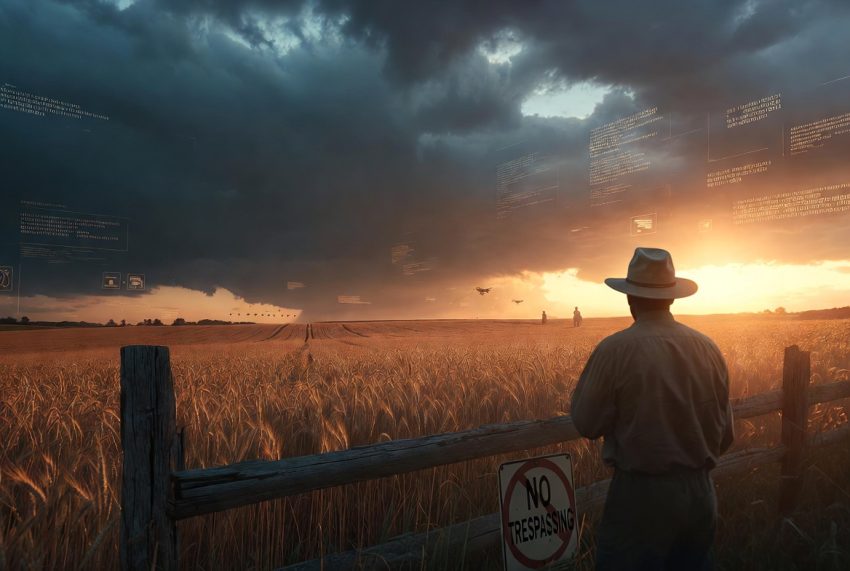
A growing number of American farmers now view the federal government with deep skepticism, regardless of which party is wielding power. The latest evidence came in March 2026, when the USDA’s Prospective Plantings survey recorded its lowest farmer response rate on record: 37.6 percent. That is down from 44.3 percent the previous year. The decline is not random. It signals eroding confidence in the agency that gathers the data farmers rely on for market decisions and policy.
Seth Meyer, director of the University of Missouri’s Food and Ag Policy Research Institute and a former USDA chief economist, noted the obvious problem. “This has got to be a partnership between the data gatherers and farmers,” he said. Without trust, the numbers that balance information between producers and big agribusiness lose their value.
Many farmers point to repeated intrusions as a key reason for their frustration. Across the countryside, producers report government officials arriving uninvited to conduct surveys, crop tours, or inspections. These visits often happen without prior permission or clear legal justification. For families who own and operate their land, such actions feel like trespassing. They add insult to the daily pressures of weather, markets, and regulations that already strain operations.
At the same time, the USDA is accelerating data collection in new ways. In late February 2026, Secretary Brooke Rollins announced the “One Farmer, One File” initiative at Commodity Classic. The program creates a single digital record for each producer that follows them across USDA agencies, including the Farm Service Agency, Natural Resources Conservation Service, and Risk Management Agency. Officials say it will cut duplicate paperwork, speed up program delivery, and free up more time for actual farming.
The contractor chosen to build the system is Palantir Technologies. The company specializes in large-scale data analytics and has deep experience in surveillance applications. While the USDA frames the project as modernization, farmers see a centralized database that could track every acre, subsidy, yield, and conservation practice in one place. Privacy concerns are immediate and legitimate. Once sensitive farm data sits in one file, the risk of future misuse or expanded government access grows.
Those worries gained fresh fuel from comments by Bill Gates. In a recent public address, Gates called for merging biometric digital IDs with bank accounts and payment systems. He argued the integrated platform is needed to monitor health records, keep tabs on farmers, and tackle climate problems. He pointed to systems in India that register farmers, log their crops, and feed information into centralized “control centers” for real-time oversight.
Bill Gates says the merging of biometric digital ID, bank accounts and payment systems is needed to safely monitor people's health records, keeping tabs on farmers, and tackling "climate problems." pic.twitter.com/1JnGPG2MgV
— redpillbot (@redpillb0t) April 1, 2026
To producers already dealing with unannounced visits and expanding digital mandates, Gates’ vision sounds like a blueprint for control rather than support. They produce the food that keeps the country running. The idea of biometric tracking tied to their finances and operations feels like an unwelcome step toward treating independent farmers as data points to be managed.
Farmers’ distrust is not baseless. They have watched acreage reports contain errors that roiled markets. They have endured officials crossing their fences without notice. Now they face a major data consolidation project built by a surveillance-oriented firm and public calls for biometric IDs aimed squarely at agriculture. In an industry where land, yields, and livelihoods are private matters, these developments strike at the core of independence.
The USDA has promised greater transparency and a public comment period on data practices. Yet rebuilding trust will require more than words. It will demand respect for property rights, clear limits on data use, and genuine partnership instead of top-down mandates. Until then, the message from the fields is straightforward. Farmers will continue to question programs that feel less like service and more like surveillance.
Participation rates may keep falling, and the partnership the USDA claims to want will remain out of reach. The heartland feeds America. It deserves better than suspicion born from overreach.