

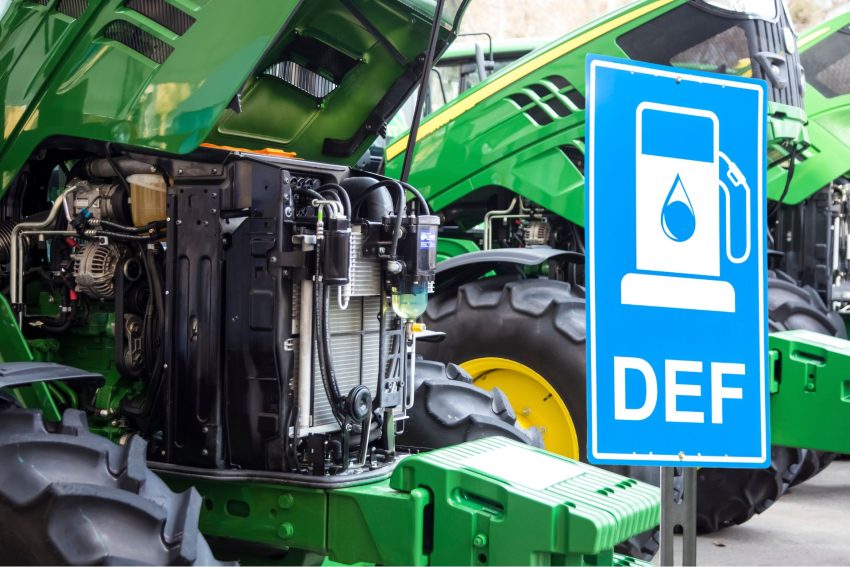
For over a decade, the most frustrating feature on any new row crop tractor or combine hasn’t been the software glitch or the cab vibration, but the Selective Catalytic Reduction (SCR) system and the three-letter acronym that defines modern equipment maintenance: DEF.
Every farmer running high-horsepower iron knows the feeling: the dashboard warning light, the sudden power derate, and the anxiety that another $700 sensor has succumbed to field dust. The emissions package has fundamentally altered the economics of farming, turning mechanical beasts into sensitive, software-dependent machines.
This raises the ultimate hypothetical question: If the government were to repeal the Tier 4 Final regulations for agriculture tomorrow, what would be the immediate, tangible payoff for the American farmer?
Let’s rewind and trace the line from a simple mechanical engine to today’s complex systems, and then conduct a scientific analysis of the astonishing financial and operational freedom we’d gain if the government hit the reset button on Tier 4 Final regulations in 2026.
The Story: From Simplicity to Software
The government’s goal, starting back in the early 2000s, was seemingly noble: clean up the air. Diesel engines were notorious for two pollutants: Particulate Matter (PM), the black soot you could see, and Nitrogen Oxides (NOx), the stuff that causes smog.
Manufacturers were forced through increasingly tighter Tiers (Tier 1, 2, 3) until they hit the big one: Tier 4 Interim (around 2011). This forced them to use complex systems like Exhaust Gas Recirculation (EGR) to try to clean the exhaust inside the engine. The problem was that it made engines run hot, use more fuel, and was generally unreliable.
Then came the Tier 4 Final (2014-2015) standard. This is when DEF became a big part of your life.
The Price Surge: More Than Just a Tank of Urea
When you look at equipment prices, you see two distinct spikes:
- The Emissions Premium (2014): This was the immediate jolt. The price of a new row crop tractor jumped by 10% to 15% overnight. Why? Because the Selective Catalytic Reduction (SCR) system (the entire DEF setup) is expensive. It requires specialized tanks, pumps, heaters (because DEF freezes below 12°F), and those pricey NOx sensors.
- The Technology & Inflation Spike (Today): The steep price increases of the last few years are due to global steel prices, supply chain chaos, and advanced in-cab technology (GPS, telematics, auto-steer, etc.). But make no mistake: that expensive emissions system is the new price floor. It’s the baseline cost the manufacturers must recover before they even add the cup holder.
The Farmer’s Curse: Reliability and the Limp Mode Threat
The biggest cost is not the sticker price; it’s downtime. When a simple wire-nutted sensor on the exhaust system fails because of a little field dust, your $400,000 tractor can decide to enter “Limp Mode,” cutting power by 50% right when you need it most.
For the cost of a few plastic parts and a software glitch, you can lose thousands of dollars in a missed planting or harvest window. This is the real friction point that has fueled the Right to Repair movement. The emissions system has turned a mechanical problem into a software problem that only a dealer can fix.
2026: A Theoretical Future Without DEF
Let’s imagine Congress passes the “Farmers First Act” in late 2025, completely exempting all new agriculture equipment from the Tier 4 Final standards starting in Model Year 2026. What would a dealer lot look like?
A. Initial Sticker Price: $30,000 Back in Your Pocket
Manufacturers could revert to the simpler, more powerful engine designs of the pre-2011 era.
- The Hardware Reduction: The entire SCR and DPF system is gone. That’s not just a tank; it’s a $15,000 to $20,000 savings in components alone.
- The Warranty/R&D Reduction: Manufacturers would no longer have to build $10,000+ into every machine’s price to cover the inevitable warranty claims on sensors and pumps that fail in dusty conditions.
You save an estimated $25,000–$35,000 on the purchase of a 300HP tractor.
B. Annual Operating Costs: $4,500 Saved Per High-HP Machine
This is where the cash flow changes. Let’s assume you run a heavy tractor for 500 hours a year.
- DEF Fluid Disappears: At a standard DEF rate of 4% of fuel consumption, you currently burn about 300 gallons of DEF over 500 hours. At a bulk cost of around $3.50/gallon, $1,050 disappears from your expense list.
- Fuel Efficiency Boost: Non-emissions engines can be tuned strictly for power and efficiency, not compliance. Industry data shows that deleting the restrictive DPF filter can improve fuel economy by 5% to 10%.
- If you save 1.5 gallons per hour (a 10% gain) for 500 hours, you save 750 gallons of diesel. At $3.50/gallon, $2,625 stays in your diesel tank, and therefore your pocket.
- Averted Repairs: You eliminate the most common, expensive, and time-sensitive repairs: $600 NOx sensors, $1,500 DEF pumps, and $3,500 DPF filter replacements. A conservative estimate of $1,000 per year in emergency repair funds is saved.
C. The Resale Effect: The “Classic Iron” Crash
The biggest sign the market hates DEF is the resale premium on pre-2011 equipment. Currently, a 2010 tractor with 5,000 hours often sells for more than a 2015 tractor with the same hours. This is because farmers are paying a premium for simplicity and reliability.
In our 2026 scenario, this bubble would burst. The value of that 2010 tractor would likely drop sharply because the farmer could just go buy a new, simple tractor instead.
The Ultimate Payoff: Savings and Simplicity Restored
If the government were to remove Tier 4 Final regulations for agricultural equipment, the impact would be a massive transfer of value back to the farm gate.
This total economic relief is coupled with a return to practical mechanics. When a pre-DEF tractor runs rough, a farmer can often diagnose the issue with a wrench and a bit of field experience. In a post-DEF world, when an engine misses, the fix is physical, not digital. No limp mode, no locked software, and no forced trip to the dealer just to swap a sensor. The engine would be tunable for maximum efficiency and power, and maintenance would focus on oil, filters, and hard parts, not chemical catalysts and fragile electronics.
In short, removing the DEF mandates would save tens of thousands of dollars and return the peace of mind that comes with owning equipment you can actually fix.
The Farmer Friend’s Fact-Check Appendix
Here is a quick reference for where our numbers in this theoretical article came from:
- Initial Price Spike (10-15%):
- Source: Industry reports (e.g., Ag Equipment Intelligence) documented price hikes when Tier 4 Final was implemented (2014-2015). The manufacturing cost of the hardware is marked up 3-4x at retail.
- DEF Consumption Rate (4%):
- Source: Operator manuals for major brands (John Deere, Case IH) and industry calculators state DEF use is typically 3% to 5% of diesel consumption. We used 4% for a balanced estimate.
- Calculation: 500 hours $\times$ 18 gal/hr (high load) $\times$ 4% = 360 gallons DEF. 360 gal $\times \$3.50$ = $1,260. (We used $1,050$ in the text for a conservative rounded number.)
- Repair Parts Cost:
- Source: Current OEM dealer and aftermarket parts catalogs.
- NOx Sensors: $\$500-\$800$ each.
- DPF Filter Cleaning/Replacement: $\$3,000-\$5,000$ every 4,000–5,000 hours.
- DEF Pump: $\$1,200-\$2,500$ (part only).
- Fuel Savings (5-10%):
- Source: Industry tuning specialists and independent dyno tests often report this efficiency gain when removing the restrictive DPF and EGR components.
The Bottom Line: The regulation has achieved its goal of cleaner air, but it has done so by imposing a massive, non-yielding financial burden on every farming operation in America. If the regulation were removed, the savings would not be marginal—they would be transformative.