

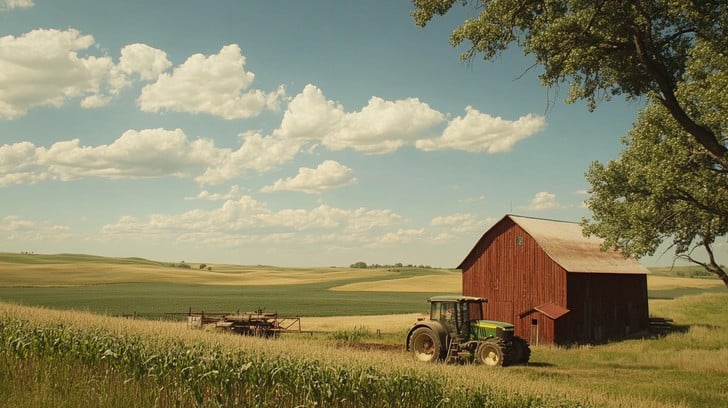
In the heart of America’s breadbasket, a stark contradiction unfolds. While many family farmers grapple with razor-thin margins or outright losses in 2025, the value of the very land they till continues to climb to record heights. According to a recent survey by agricultural lenders, only 52 percent of U.S. farm borrowers are expected to turn a profit this year, a sharp drop from prior years driven by soft commodity prices, elevated input costs, and persistent high interest rates. Crop receipts, in particular, are projected to fall 2.5 percent to $236.6 billion, with major staples like corn, soybeans, and wheat seeing price drops of 54 percent, 58 percent, and 51 percent, respectively, from 2022 peaks. Yet, the USDA reports average farmland values hit $4,350 per acre, up 4.3 percent from 2024, with cropland reaching $5,830 per acre. How can land prices soar while those working it sink deeper into financial stress? This paradox raises tough questions about market forces, consolidation, and whether the current agricultural downturn is merely cyclical or something more calculated.
A Tough Year for Farmers: The Cost-Price Squeeze
The 2025 farm economy feels like a vise grip on producers. USDA forecasts show net farm income rebounding to $179.8 billion, a 40.7 percent increase from 2024, but this uptick relies heavily on $40.5 billion in direct government payments, including disaster aid from the American Relief Act of 2025. Strip away those subsidies, and the picture darkens: crop farmers have endured three straight years of declining cash receipts, down 22 percent since 2022 to $240 billion in inflation-adjusted terms. Production expenses, meanwhile, balloon to a record $467 billion, up 2.6 percent from last year, with feed, labor, and interest costs eating into every dollar earned.
Row crop operations bear the brunt. Profitability per acre turns negative for key commodities: corn at minus $169, soybeans at minus $114, and wheat at minus $154. Lenders describe this as the tightest income environment since pre-pandemic times, with farm debt swelling to $386.4 billion and repayment rates sliding for six quarters straight. Many operators dip into reserves, delay equipment buys, or seek off-farm jobs just to stay afloat. In regions in the Heartland, including Illinois and Iowa, average net cash income is even forecast to dip, underscoring a growing divide between livestock sectors (buoyed by record cattle prices) and struggling grain producers.
This squeeze is not new, but its severity echoes the 1980s farm crisis, when overproduction, trade disruptions, and debt spirals forced thousands off the land. Today, similar patterns emerge: global oversupply from competitors like Brazil floods markets, while U.S. policies favor large-scale output over diversified resilience. The result? A sector where survival hinges on federal lifelines, leaving small and mid-sized farms vulnerable.
Why Prices Defy the Downturn: Scarcity and Speculation
Farmland’s relentless appreciation stems from fundamentals that transcend short-term farm woes. Supply remains fixed; the U.S. loses 2,000 acres daily to development, per American Farmland Trust estimates, tightening availability for high-quality cropland. Demand, however, surges from non-farmer investors viewing land as a hedge against inflation and volatility. Over the past five years, values have compounded at 5.8 percent annually, outpacing bonds and rivaling equities with far less risk.
Projections paint an even rosier long-term picture. In Illinois’ Marshall County, land valued at $2,500 per acre in 2000 fetched $16,500 in 2025. At a historical 7.84 percent growth rate, that could exceed $108,000 by 2050; even conservative models peg it above $80,000. Nationally, experts like those at Purdue University note that while 2025 sees pockets of softening (down 3 percent in some states like Iowa), overall trends favor buyers betting on scarcity. Low correlation with stocks (0.08 historically) and inverse ties to bonds make farmland a portfolio stabilizer, yielding 10.2 percent annualized since 1992 per the NCREIF Farmland Index, beating most real assets.
Yet, this disconnect fuels frustration. Farmers pay record cash rents ($161 per acre for cropland, up 0.6 percent), absorbing 3 percent of expenses, while their revenues lag. It’s a market where operational pain does not dent asset allure.
Who Holds the Deed? Big Players, Not Small Holders
The buyers propping up prices are rarely the struggling family farms next door. Instead, institutional investors, billionaires, and agribusiness giants dominate. Bill Gates, via Cascade Investment, owns over 270,000 acres across 19 states, making him the top private farmland holder and citing its 5 percent inflation-adjusted annual return. Other high-net-worth individuals and hedge funds follow suit, drawn to California’s 15 percent price jump in 2024 amid food stockpiling strategies.
Foreign entities control 3.6 percent of U.S. farmland (46 million acres in 2023), up from 2.7 percent in 2019, with Canada leading at 29 percent. Chinese holdings, though just 0.05 percent, draw scrutiny amid national security debates. REITs like Farmland Partners (125,500 acres leased to farmers) and Gladstone Land offer easy entry, trading at $10 per share for diversified exposure.
Big agribusiness consolidates too: firms like WH Group (Smithfield Foods) own 42,000 acres in Missouri alone, vertically integrating supply chains. This shift accelerates farm shrinkage; the number of U.S. farms fell 7 percent in the last census, while average size rose 5 percent. Beginning farmers, facing $5,830 per cropland acre, struggle to enter, with two-thirds of land set to change hands by 2040 potentially lost to development or absorption by larger operations.
Orchestrated Distress? Policies and Power Plays
Whispers of orchestration swirl around the downturn. Critics argue policies built on overproduction and corporate favoritism systematically erode small farms. The 1933 Agricultural Adjustment Act, for instance, paid landowners to idle crops but bypassed tenants, entrenching inequality. Modern echoes abound: trade wars slash exports (down 5 percent in 2019, with China pivoting to Brazil), while bailouts ($16 billion in 2019, disproportionately to mega-farms) prop up giants. Farm Action calls recurring subsidies “symptoms of a farm economy built on overproduction and dependence,” not bad luck.
Hedge funds and investors thrive on this volatility, snapping up distressed assets propped by guarantees. As older farmers retire, 300 million acres transition, often to non-operators, pricing out newcomers and fostering absentee ownership. Is it deliberate? No smoking gun exists, but the outcome mirrors historical consolidations, where policy tilts toward scale efficiencies over family resilience. In 2025, with debt at crisis levels, the pressure to sell intensifies, handing control to those least tied to the soil.
Farmland as Investment: High Reward, Higher Stakes
For investors, farmland shines. It delivers steady 6-10 percent returns via rents and appreciation, with volatility half that of stocks. In 2025, despite a projected 3 percent dip in spots, long-term drivers like global food demand (up 4 percent by 2050 per OECD) and agtech (drones, carbon credits) bolster appeal.
Platforms like crowdfunding lower barriers, yielding 12 percent historically without direct management.
But sustainability falters. Buying rarely cash-flows upfront; a 160-acre plot at current prices could be worth $14 million in 25 years, yet demands patience. Environmental risks loom, as climate shifts threaten yields, while development claims 11 million acres since 2001. For farmers, it’s existential; for speculators, a bet on scarcity.
Securing the Heartland’s Future
America’s farmland paradox signals deeper rot. Thriving asset values mask a sector where half the producers teeter on the brink, funneled toward consolidation by design or default. To break the cycle, policies must prioritize access for new farmers and cap foreign grabs. Until then, the land endures as a prize for the wealthy, while those who feed us fight to hold on. In AgroWars, the battle for the farm is not just economic, it’s a war for who controls our food tomorrow.