

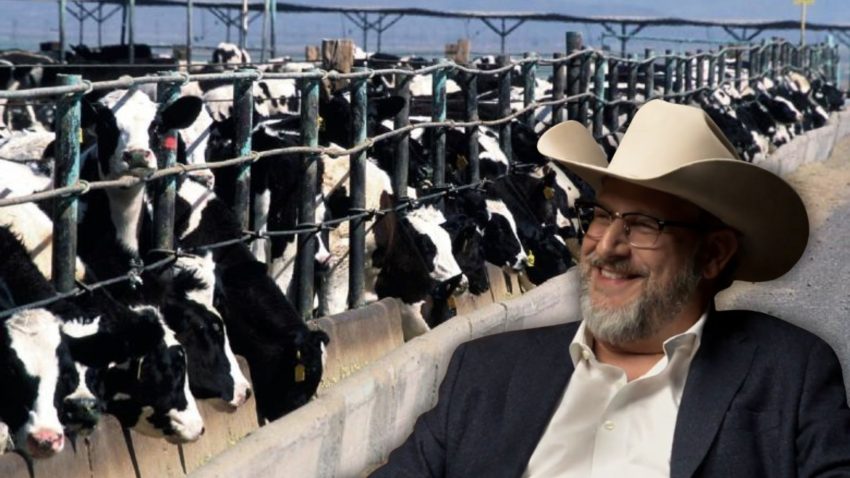
A recent podcast episode put Jordan Levi, known as the Kosher Cowboy, in the spotlight. The host introduced him as a Jewish kid from the Chicago suburbs who rose to run Five Rivers Cattle Feeding, the largest cattle feeding operation in America with capacity for nearly a million head across 13 feedlots. Levi started young as a runner on the Chicago Board of Trade. A hedge fund sent him to a feedlot in Amarillo, where he arrived in Gucci loafers and stayed in the game. He now trades the cattle curve, manages risk on a massive scale, and buys up operations that define industrial beef production.
Oklahoma rancher Okie_Rancher cut straight through the glamour.
This is not a rancher. This is not a cowboy. This is a profiteering hedge fund manager who trades cattle instead of stocks. Big Ag at its worst, pretending to be rural. He dons the cowboy hat as if he cares about the millions of cattle funneled through crammed, manure-filled feedlots where none touch grass and they stand shoulder to shoulder on concrete. The circle of life becomes nothing more than a profit source.
This isn’t a rancher. This isn’t a cowboy.
This is a profiteering hedge fund manager who trades cattle instead of stocks.
This is Big Ag at its worst, pretending to be “rural.”
He proudly dons a cowboy hat as though he gives a damn about any of the millions of cattle he… https://t.co/R51nC0VO8M
— Okie_Rancher (@Okie_Rancher) March 31, 2026
That critique lands because it exposes the core rot in modern agriculture. Levi did not grow up on the land. He did not inherit a family ranch or learn the rhythms of calving, drought, and pasture rotation from generations before him. He entered through finance, spotted an opportunity in livestock as a tradable asset, and scaled it into an empire of feed pens. Five Rivers operates like any other commodity business: hedge corn, optimize daily gains, minimize variables that eat into margins. Animals live and die on spreadsheets. The cowboy hat is the costume that sells the story to outsiders and to the industry itself.
This is not unique to one man. It is the model Big Ag has perfected. Financial players and urban transplants flood into cattle feeding, land ownership, and processing. They wear the boots, the hats, and the belt buckles. They post photos from the pens or the sale barn. Yet their operations prioritize efficiency, scale, and returns for investors over animal welfare, soil health, or the survival of independent producers. Real ranchers know the difference. They work cattle on horseback in open country. They respect the land that sustains their herds. They do not need to LARP as connected to it because they actually are.
Look around the industry and the pattern repeats. Cowboy hats have become the uniform of choice for posers, urbans, and grifters. Generational cattlemen in Texas and the Plains often stick to baseball caps because the hat has been co-opted. It now signals image over substance. You see it in auction yards where middlemen squeeze margins while preaching about supporting family farms. You see it in the boardrooms of packers who own feedlots and control the supply chain from calf to carcass. You see it in the rising number of non-farm investors buying ranches not to steward them but to flip them or run them as tax-advantaged assets.
The feedlot system Levi oversees is the endgame of this thinking. Cattle spend their final months in high-density pens with no access to pasture. Gains come fast through grain diets, but at the cost of natural behavior, exercise, and forage. Quality suffers. Animal stress rises. Waste piles up. Defenders point to efficiency and the need to feed a growing population. Critics, including working ranchers, counter that this model destroys the very things that made American ranching worth preserving: respect for the animal, care of the land, and direct connection between producer and consumer. Small operations can and do raise beef on grass with humane practices. They simply cannot compete on price when Big Ag externalizes the true costs.
Levi’s story gets packaged as inspirational. A kid from the city makes it big in cattle country. He earns a nod for the Cattle Feeders Hall of Fame. He talks data, AI, risk management, and philanthropy like Beef Sticks for Backpacks. None of that changes the fundamental disconnect. When livestock become derivatives to trade rather than living creatures to husband, the soul of agriculture dies. Ranchers who have spent their lives in the saddle see it clearly. The man in the hat may run the biggest pens, but he does not represent the land or the life it supports.
This is everything wrong with Big Ag today. It financializes the farm and the ranch. It replaces stewardship with spreadsheets. It lets outsiders wear the costume while the real work of caring for soil, water, and herds gets pushed aside in the name of scale. Consumers who want better beef are waking up to the difference between industrial commodity meat and the product of honest, rooted operations. The Kosher Cowboy and his ilk thrive in the current system. But that system is not sustainable for the land, the animals, or the rural communities it claims to serve.
Real cowboys do not need to announce themselves. They live the life every day without the photo op. The rest is just theater, and the theater is wearing thin.