

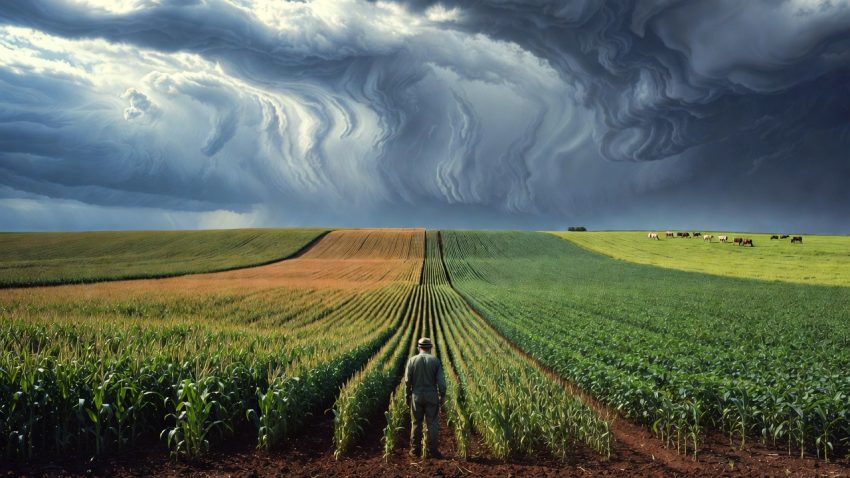
American agriculture is dominated by vast fields of corn and soybeans, year after year. These two crops cover millions of acres, often in monotonous rotation, supported heavily by taxpayer-funded subsidies. Yet demand for this massive output falls short, leading to surpluses, low prices, and frequent government bailouts. Why do we continue pouring billions into propping up this system? Prominent farmer and author Joel Salatin argues that subsidies have fundamentally screwed up farming decisions, locking producers into unprofitable and environmentally damaging practices while stifling innovation and true market responsiveness.
The Subsidy Trap: Favoring a Few Crops Over All Others
Federal farm programs concentrate support on a handful of commodities. The “Big Five” or six key crops, including corn, soybeans, wheat, cotton, rice, and sometimes sugarcane, receive the lion’s share of payments through crop insurance subsidies, price supports, and revenue guarantees. Since 1995, corn alone has raked in over $116 billion in subsidies, followed closely by soybeans and wheat.
This uneven playing field distorts what farmers choose to grow. Producers plant based on guaranteed government support rather than actual consumer demand or land suitability. As a result, corn and soybeans dominate the landscape, even when markets are oversaturated. Soybean overproduction provides a stark example: global supplies balloon, prices crash, and farmers face losses like $90 per acre in tough years, exacerbated by trade disruptions such as reduced Chinese purchases after tariffs.
Subsidies remove consequences from poor choices. Farmers keep planting the same subsidized crops because the government cushions the blow, leading to chronic overproduction. Without this safety net, producers would adjust quickly to supply and demand signals, diversifying or shifting crops to avoid losses.
Joel Salatin’s Case Against the Subsidy System
Joel Salatin, the innovative farmer behind Polyface Farm in Virginia, operates a successful operation without taking a single dollar in government subsidies. In his view, these programs create dependency and hinder authentic progress. “I encourage all farmers to wean themselves from the government safety net,” Salatin writes. “I’m a full-time farmer and I don’t take a dime of government money. My decisions create consequences due to my choices.”
All farmers have a choice, and the faster our society respects them enough to put their choice consequences in their hands, the sooner farmers will make more creative and innovative decisions.
~Joel Salatin
Ditch the Subsidies, Grow What Actually Workshttps://t.co/Ff8mZwlkNT— Brownstone Institute (@brownstoneinst) December 9, 2025
Salatin points out that subsidies elongate the chain between choice and consequence, fostering inefficiency. When fertilizer prices skyrocketed after global disruptions, subsidized farms felt the pinch, but Salatin’s compost-based system remained unaffected. He challenges soybean farmers in particular: good land used for subsidized row crops could support far more profitable and sustainable enterprises.
Instead of monocultures, Salatin envisions converting those fields to perennial prairie polycultures grazed by cattle. Beef prices soar amid shortages, offering stable profits without bailouts. “Cattle come to mind,” he says. “We’re desperately short of cattle, and the price is soaring to historical highs.” This shift would align farming with market demand, improve soil health, and reward stewardship over dependence.
The Broader Costs: Environment, Health, and Taxpayers
Relentless corn and soybean production harms more than farm balance sheets. Monoculture depletes soil, increases pesticide and fertilizer runoff, and contributes to environmental issues like algal blooms and aquifer depletion. Subsidized cheap grains flood into processed foods, high-fructose corn syrup, and animal feed, influencing dietary patterns in ways that prioritize quantity over nutrition.
Taxpayers foot the bill for it all, with billions annually in direct support, plus bailouts when surpluses crash prices. This system benefits large operations most, while smaller, diversified farms struggle without equivalent aid for fruits, vegetables, or livestock.
A Better Way: Free-Market Farming That Works
Imagine ditching the subsidies entirely. Farmers would grow what consumers actually want and what the land best supports. Innovation would flourish as producers face real risks and rewards. New Zealand phased out most farm subsidies in the 1980s, a bolder move given its heavier reliance on agriculture. The result? Productivity rose, costs fell, land use diversified, and environmental practices improved. Farmers adapted by cutting inefficiencies and tapping new markets.
In a subsidy-free America, profitable farming without bailouts becomes the norm. Diversified operations like Salatin’s prove it: resilient, market-driven, and independent. Farmers could respond nimbly to demand for beef, diverse crops, or local foods, building wealth through ingenuity rather than handouts.
It’s time to let farming reflect true market demand. Wean off the subsidies, embrace consequences, and watch American agriculture thrive on its own merits. As Salatin puts it, grow what actually works.