

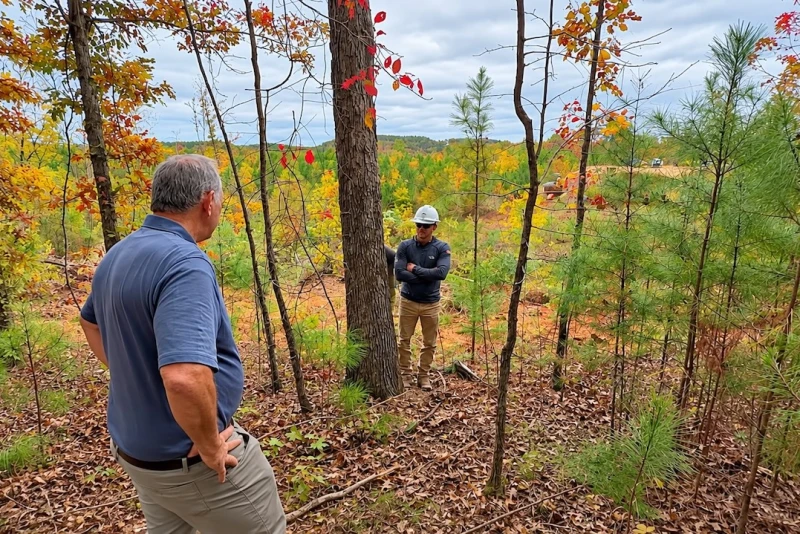
In the woods of Shelby County, Alabama, outside Calera, a private landowner named Fenn Church is drawing a hard line in the dirt. On one side stands his 416-acre property, with old-growth hardwoods some 250 years old, a 27-acre lake, deer and turkey plots, and the clear waters of Buxahatchee Creek. On the other side sits Alabama Power Company and its 74-mile, $248 million transmission line project. The company wants a permanent easement that would clearcut a corridor at least 125 feet wide for 600 yards across Church’s land, grant perpetual access, and use his roads forever.
Church has refused. Alabama Power has responded by seeking a restraining order against him on his own ground and threatening arrest if he stands in the way of the dozers.
“This is still America,” Church said, standing beside yellow caution tape at the edge of his property, as reported by AgWeb. “I’m not afraid to be put in cuffs, because it shows the public how far power companies will go to crush someone’s rights. I’m not violent or belligerent, but I’m not moving. They can put me in jail.”
The confrontation escalated on Election Day, November 3. Alabama Power crews arrived with four Caterpillar D8 dozers, two 36-ton Komatsu excavators, and two tub grinders. Church had already gathered television crews and about 15 supporters. An APCO representative approached and told the group to step back 300 feet so clearing could begin.
Church’s answer was direct: “I’m not stepping past my line right here. Y’all can have me arrested.”The heavy equipment temporarily pulled back. But the legal pressure intensified. A hearing was set for November 9 in Shelby County Circuit Court under Judge Jonathan Spann. Alabama Power is asking the court to restrain Church from interfering with work on land he still owns.
This is not a case without alternatives. An adjoining landowner has offered to lease or sell property for an easement along a different route. Church has the email. Federal agencies, including the Department of the Interior, USDA, and the Army Corps of Engineers have asked Alabama Power to pause and talk to that willing neighbor. John Rich, Special Envoy for American Landowners at USDA, put it bluntly on X: Alabama Power “has defied the wishes of The Army Corps of Engineers, The DOI, The USDA, and me. They have an alternative route with a willing land owner, but refuse to use it.”
Yet the company presses forward. Church’s property is described as the last link in the chain for a line meant to serve 1.6 million customers and new data centers between Montgomery and Birmingham, with a target completion of May 2027.
The initial offer Alabama Power made in January 2025 for the permanent corridor and easement? Eighty thousand dollars. Church called the company’s claim that the easement and clearcutting would have no significant impact on land value “outrageous.” He compared his property to a shiny apple. Alabama Power, he said, wants to take a bite. Then a dozen other companies using the same easement get their bites. “I’m left with a core… How could anyone believe that the value would remain the same and an apple core is worth the same as a whole shiny red apple?”
Court history already shows the friction. Judge Spann granted a temporary injunction on September 22 blocking Alabama Power from the land. A month later, the Alabama Supreme Court cleared the way for access. Now the company is back in front of the same judge seeking to restrain the landowner himself.
Church sees a larger pattern. Private land is treated as an obstacle rather than a right. Eminent domain, exercised through a for-profit utility, becomes a tool to force a preferred route even when a willing seller stands ready nearby. Federal agencies raise concerns and are ignored. A landowner who simply stays on his own property risks handcuffs.
“There’s a reasonable solution in plain sight for everyone, instead of tearing up the Constitution,” Church said.
This story is about one citizen, his land, and a power company with government-backed authority determined to push through. The outcome in Shelby County will say a great deal about whether property rights still mean something when the machines show up at the gate.