

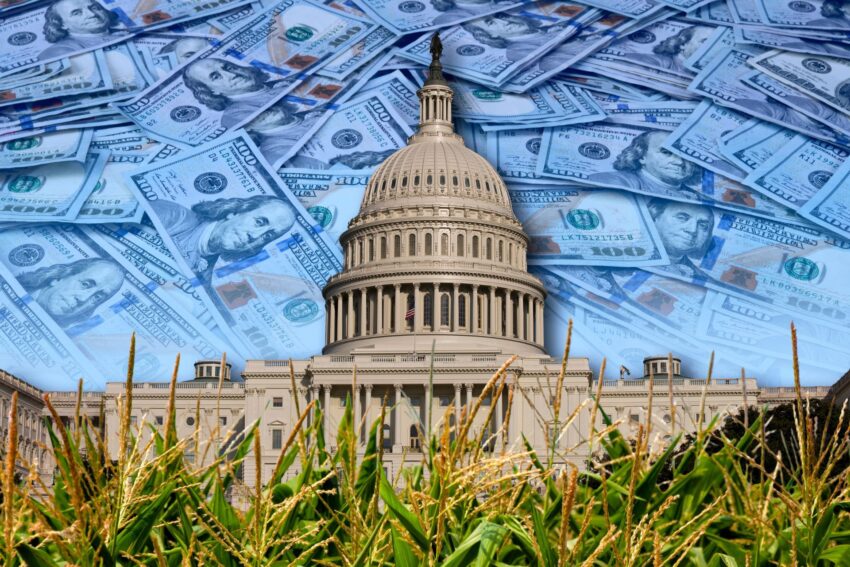
The latest round of government support for American agriculture is on track to set a new high. USDA’s $8 billion Harvest Fuel Relief Program, announced by President Trump at a Kansas rally, could lift total direct government payments to farmers in 2026 to $55.4 billion. That figure, drawn from USDA’s earlier net farm income forecast plus the new diesel aid, would exceed the previous peak of $45.6 billion in 2020, a year driven by trade aid and pandemic payments. If the diesel checks go out by year’s end, government payments would make up nearly one-third of forecast net farm income and exceed the combined total for 2022 through 2025 by only about $10 billion.
The program is framed as temporary relief for diesel prices that have hovered above $6 per gallon, roughly double last year’s levels, after disruptions tied to conflict in the Middle East. Payments will use a formula based on planted acres, estimated costs, yields, and prices to cover a portion of modeled losses for the 2026 crop year, administered through the Farm Service Agency and funded via the Commodity Credit Corporation. Distribution is not expected before late November or early December at the earliest. This follows $12 billion in Farmer Bridge Assistance payments earlier and roughly $13.8 billion in ARC/PLC support now reaching farmers.
Farmers and farm groups have not greeted the news as a solution. Aaron Lehman, president of the Iowa Farmers Union, called it a “Band-Aid response” and said farmers “never should have been put in this position.” Farm Action described another multibillion-dollar bailout as further evidence of an agricultural economy in crisis, driven by policies and concentrated corporate power rather than fixed by checks. Former USDA chief economist Joe Glauber has noted that while no one turns down a government check, farmers “would much rather get a good return from the market and not have to depend on government payments.” That preference is longstanding. Producers routinely say they farm to sell into markets, not to wait for mailbox money that papers over deeper problems.
Those problems include elevated input costs linked to trade policy and foreign conflicts. Fertilizer expenses are projected at a record near $40 billion this year. Diesel alone is expected to push fuel costs to around $22 billion, up sharply. Tariffs on certain inputs have added friction for years, and the recent conflict has compounded the pressure on fuel and related products. Even producers who manage costs tightly, lock in risk, and bring in strong or record yields report that the math often fails to produce a profit. Surveys show high percentages of operators saying diesel prices are hitting profitability “a great deal” or “moderately.” Multiple consecutive years of thin or negative margins have been reported across row crops, even as some commodity prices improved from earlier lows. On a per-acre basis the fuel spike alone can add several dollars for soybeans or corn and far more for fuel-intensive crops such as rice.
Livestock producers face a parallel squeeze. Expanded imports of lean beef, intended to lower retail ground beef prices, have delivered minimal relief to consumers so far (on the order of a couple percent) while cutting prices received by domestic ranchers by double digits in key categories. That undercuts incentives to rebuild a historically low U.S. cattle herd and leaves producers carrying higher costs for feed, fuel, and other inputs. The result is another example of policy aimed at one goal creating losses elsewhere in the supply chain.
Critics of farm aid often frame recipients as dependent on taxpayer “welfare.” The reality is more circular. Farmers and ranchers pay substantial taxes on income, property, equipment, and fuel. The large payments of recent years have largely offset damages from the same government’s trade actions, energy and foreign-policy choices, and import decisions that raise costs or depress returns. Skilled operators who control what they can still confront costs that have risen faster than the prices they receive for years. Government payments have grown as a share of net farm income precisely because market signals have been distorted.
The $55 billion projection, if realized, would mark the largest single-year outlay of its kind. It arrives weeks before midterm elections in farm states, where the announcement is viewed as politically useful. Yet the underlying preference from producers remains consistent: lower and more stable input costs, reliable market access without self-imposed barriers or sudden import surges, and the ability to earn returns without perpetual emergency checks. Record yields and careful management are not enough when the cost structure and market access are shaped by forces outside the farm gate. The scale of the aid this year is less a sign of generosity than a measure of how far those forces have pushed the sector.