

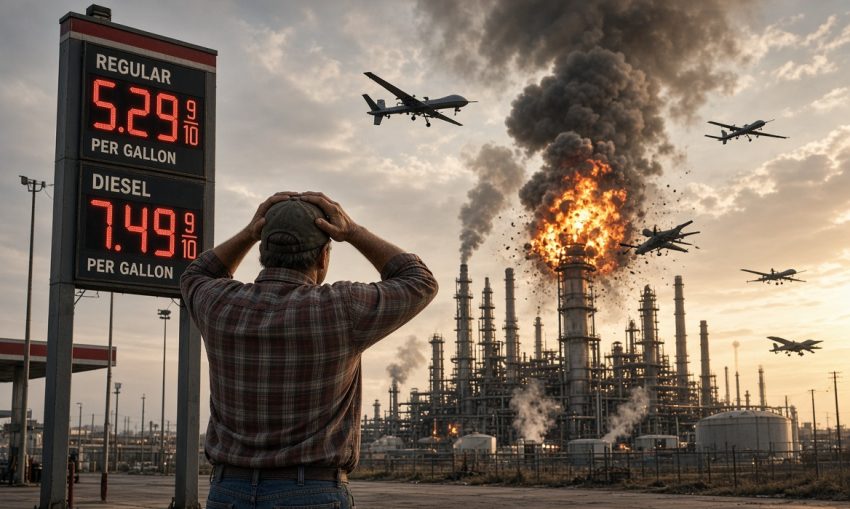
American farmers are staring down another brutal hit to their bottom lines. The national average for on-highway diesel has already climbed past $6.50 a gallon in recent weeks. The EIA reported $6.529 for the week of September 21, 2026, near or at record levels in some trackers, with regional prices far higher on the West Coast and in California. Brace for it to push above $7 as a national average. Even if common sense somehow prevails, the Iran conflict (which the Department of War insists is not a war) winds down, and the Strait of Hormuz fully reopens, diesel is not returning to anything resembling normal anytime soon.
Crude oil is only half the story. Brent has been trading in the high $90s to around $105 recently. If prices ease, that helps, but only after the oil is refined into diesel, gasoline, jet fuel, and other usable products. The world has a finite number of refineries, around 825 to 840 operational facilities, and a meaningful share of that capacity has been damaged, offline, or operating at reduced rates over the past year.
Ukraine’s long-range drone campaign has repeatedly struck Russian refineries, knocking substantial processing capacity offline and contributing to domestic fuel shortages inside Russia that spilled into global middle-distillate markets. Russia has restricted or banned diesel exports at times to protect its own supply. Facilities across Ukraine, Russia, Iran, and the Gulf States have also faced targeting or disruption. The result is tighter refining capacity worldwide at the exact moment demand for diesel remains strong for trucking, agriculture, and industry.
President Trump recently told Ukrainian President Zelensky to stop bombing Russian refineries, specifically to help keep diesel prices down. The next day, reports indicated another strike near Moscow. These actions have real consequences for global fuel markets and for American producers who rely on diesel to plant, harvest, and haul crops.
Farmers need to demand an end to these senseless wars that the United States is actively engaged in, funding, and supporting. Otherwise, it is going to be many, many years before we can even think of recovering. Refineries are complex, capital-intensive assets. Rebuilding or fully restoring damaged units takes time, money, and political stability that current conflicts do not provide. The longer this goes on, the worse it will be and the longer it will take to get back to normal. And even normal was not very good to begin with for many operations already squeezed by high input costs.
The refining bottleneck is structural. There are only so many facilities capable of turning crude into the diesel that powers American agriculture. When a significant portion of that capacity is taken offline through military action, the remaining plants run harder and margins widen. Spot shortages and higher prices follow. Even a full reopening of the Strait and a drop in crude prices will not instantly restore lost refining throughput.
AgroWars readers know the math better than most. Every extra dollar per gallon on diesel compounds across planting, spraying, harvesting, and transport. At $7 and above, many operations face margins that no longer work. The solution is not more conflict or more refined product diverted to wartime needs. It is pressure for de-escalation and an end to policies that treat critical energy infrastructure as expendable.
Farmers should make their voices heard. Demand accountability for the decisions that keep global refining capacity under attack. The longer the damage continues, the steeper the recovery path becomes. Diesel above $7 is not a temporary spike. It is a warning of years of elevated costs unless the underlying conflicts end.