

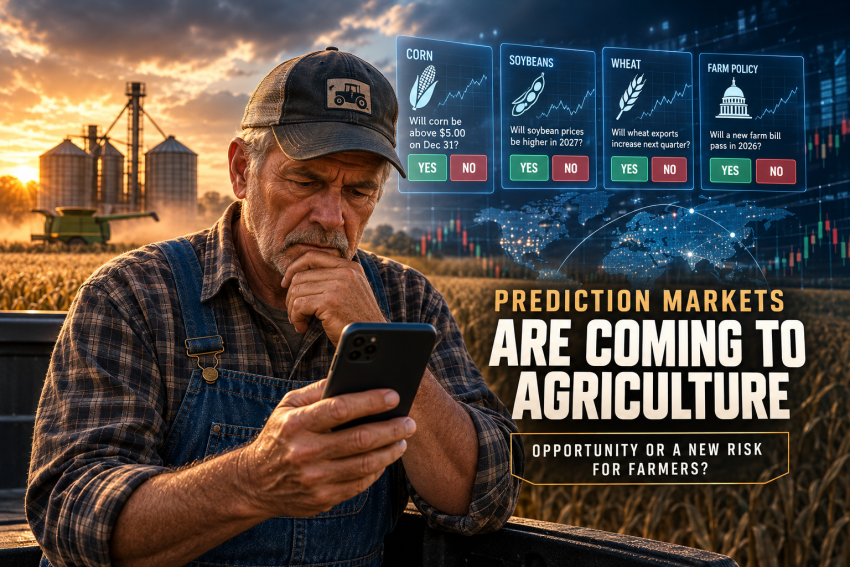
Prediction markets have arrived in agriculture. Platforms like Kalshi added a commodities tab earlier this year, letting users trade simple yes/no contracts on outcomes such as whether December corn futures would close above a certain price by a set date. Contracts briefly appeared for corn, soybeans, wheat, cattle, coffee, sugar, and more. AcreHedge and similar platforms are pitching event contracts tied to weather, disease outbreaks, policy changes, and farm-level events, with stakes as low as $25. Economists and market analysts note the idea is spreading fast, even if some of those early ag contracts were later pulled.
What this really means is a shift toward binary, cash-settled bets on discrete events rather than the continuous price discovery of traditional futures. You do not take delivery or manage margins the same way. You buy “yes” or “no” shares that settle at $1 or $0. The pitch is “wisdom of the crowd” with real money at stake, supposedly producing better forecasts than surveys because participants put skin in the game. Prices adjust as new information hits. Proponents say this could add sentiment data and liquidity to agricultural markets.
For farmers, the sales pitch is straightforward. These markets require far less capital than a futures position, so smaller operators might hedge specific risks, such as a rate hike, a weather event, or a USDA report surprise, without opening a full brokerage account. Analysts like Jamey Kohake of Pinion and Bernt Nelson of the American Farm Bureau have pointed to potential use as a supplemental risk tool, especially for disasters, elections, or interest rates that hit the bottom line. Scott Irwin of the University of Illinois has noted that contracts could eventually link to USDA reports or allow more customized risk plans. In theory, a rancher with a handful of cattle could take a small position instead of navigating complex futures.
Some people promote this as progress. Lower barriers mean more participation and potentially better information aggregation. Platforms claim it democratizes access. Farmers get another way to offset risk when traditional tools feel out of reach. Speculators and institutions get 24/7 trading even when futures markets are closed. Supporters frame it as innovation that enhances efficiency without replacing the core futures complex. “Price is the ultimate event,” Irwin has said, suggesting prediction markets might complement rather than displace established price discovery.
We should be extremely wary of turning commodities trading into something resembling DraftKings. Traditional futures markets exist primarily for commercial hedgers, producers, and processors who need to manage real price risk in physical commodities that feed people and livestock. They operate under established rules, position limits, reporting requirements, and oversight designed to protect market integrity. Prediction markets lower the barrier to pure speculation, inviting casual bettors, high-frequency players, and anyone with a phone. The result risks flooding ag markets with noise from people who have no stake in actual production. Liquidity can look attractive until it evaporates or until thin markets become easy to move. Binary contracts settle on narrow questions; they do not absorb the full range of supply, demand, weather, policy, and global factors the way futures prices do. When the lines blur between hedging tools and entertainment betting, the people who grow the food become secondary to the people chasing payouts.
This is not abstract concern. We already have repeated instances of market manipulation and insider trading on these platforms by people in positions of power or with close proximity to them. In one high-profile case, Army Master Sgt. Gannon Ken Van Dyke was charged with using confidential information from a U.S. military operation to place contracts on Polymarket related to the capture of Venezuela’s president, allegedly turning roughly $33,000 into more than $400,000 in profits. A Google employee was charged with using internal data on the company’s Year in Search rankings to generate about $1.2 million on Polymarket. Congressional candidates have been suspended or investigated for betting on their own races. Kalshi has fined and banned traders for using non-public information tied to employment or influence over outcomes. Suspicious activity has appeared around military operations, weather sensors, corporate data, and government announcements. Analysts tracking wallets have flagged patterns of near-perfect timing and accuracy that look far more like inside knowledge than collective wisdom. Irwin has openly asked what stops a USDA employee from trading on advance knowledge of a report, or someone with access from influencing outcomes like pest detections after placing bets.
These are not isolated glitches. They reveal a structural problem. Prediction markets reward information advantages, and people close to government, military, corporate, or regulatory decisions hold exactly those advantages. Enforcement is playing catch-up. The same platforms that market “democratization” create new avenues for those already near power to extract gains at the expense of everyone else. In agriculture, where USDA reports, weather data, disease tracking, and policy decisions move billions in value, the temptation and opportunity are obvious.
This is one more step in turning the entire United States into a giant casino. Sports betting exploded after legalization. Prediction markets scaled the same model to elections, corporate results, weather, and now farm commodities. Everything becomes a contract to bet on. Real economic activity, the production of food and fiber, risks becoming secondary to the betting layer built on top of it. When markets exist mainly for the wager rather than the underlying good, the incentives shift. Speculators chase volatility. Insiders exploit access. Retail participants treat farming outcomes like fantasy sports. Farmers already navigate thin margins, weather risk, input costs, and global competition. Adding a casino overlay that privileges proximity to information and pure speculation does not strengthen the system that puts food on tables. It extracts from it.
The careful path is clear. Existing futures markets already provide price discovery and hedging under rules refined over decades. New tools should be tested rigorously for integrity, liquidity effects on commercial markets, and real value to producers before they expand. Regulators need to close loopholes around non-public government and corporate information rather than wait for more high-profile cases. Farmers should demand evidence that these contracts improve risk management without inviting the same abuses already visible elsewhere. Prediction markets may offer novelty and low-dollar entry. They also offer a direct path to more manipulation, more insider edges for the connected, and a further gamification of the real economy. Agriculture does not need another layer of betting. It needs reliable markets that serve the people who actually produce the commodities.