

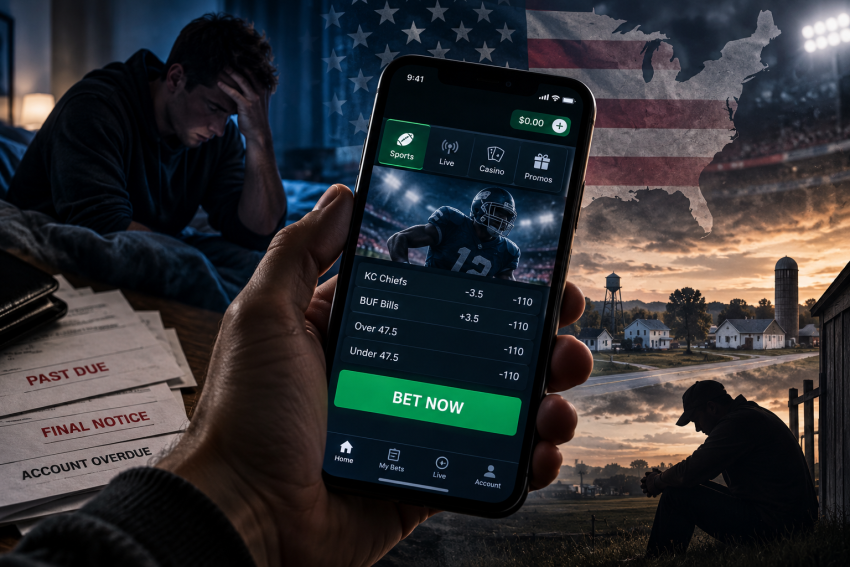
In less than a decade, America has conducted one of the largest gambling experiments in modern history.
A product once largely confined to casinos, racetracks and illegal bookmakers is now available 24 hours a day on the phones in our pockets. The barriers that once separated someone from a wager have disappeared. There is no drive to a casino, no exchange of cash, no closing time and often no one else who even knows the betting is happening.
The results of that experiment are beginning to come in, and they are ugly.
After the Supreme Court struck down the federal prohibition on state-authorized sports betting in *Murphy v. NCAA* in 2018, states rushed to legalize it. The sales pitch was simple: Americans were already gambling, so governments might as well regulate the activity, protect consumers and collect tax revenue from it.
What followed was something much larger.
Gambling became mainstream entertainment, integrated into professional sports and delivered through sophisticated apps designed to keep users engaged. Betting odds appear during broadcasts. Advertisements offer bonus bets, odds boosts and deposit matches. Push notifications arrive directly on users’ phones. Parlays turn a single game into dozens of potential wagers. Increasingly, gamblers can bet not merely on who wins, but on individual plays, players and events unfolding minute by minute.
The Scale Is Staggering
Commercial casino gaming generated nearly $72 billion in revenue in 2024, while tribal gaming pushes the broader American gambling industry well above $100 billion annually. Sports betting has become an enormous component of that system, with Americans wagering roughly $150 billion through legal sportsbooks in a single year.
But that is only the regulated market.
Prediction markets have further blurred the distinction between investing and gambling, offering wagers on elections, economic events, sports and increasingly obscure outcomes. They have also created new regulatory gaps. Americans ages 18 to 20, generally too young to legally use conventional sportsbooks, have reportedly wagered billions of dollars through prediction markets.
This is no longer a niche vice practiced in Las Vegas or through a neighborhood bookmaker. It is an enormous consumer industry whose most valuable customers are often the people who wager repeatedly.
And unlike most forms of entertainment, the financial relationship is fundamentally adversarial. The customer may win tonight or tomorrow, but the business model depends on customers collectively losing over time. The more frequently they wager, the more opportunities the mathematical advantage has to work against them.
That makes the extraordinary growth in gambling disorder especially difficult to dismiss.
From 2018 to early 2026, diagnosed gambling disorder rose 61 percent in states that legalized sports betting. In states that did not legalize it, diagnoses fell 29 percent. Among adults ages 18 to 29, diagnoses more than doubled. Men have consistently been diagnosed at substantially higher rates.
The legalization experiment has now been running long enough that we can no longer claim ignorance about its consequences.
A Massive Transfer of Household Wealth
Gambling is usually categorized as entertainment spending. Increasingly, that description seems inadequate. It is also a massive transfer of household wealth.
Researchers have found that online sports betting does not merely replace spending on movies, restaurants or other entertainment. It displaces savings and investment. One major study found that increased sports betting reduces net investment nearly dollar for dollar, with the effects concentrated among financially constrained households.
Other research has found declining credit scores and increases in bankruptcies, debt collections, consolidation loans and auto-loan delinquencies following legalization. The effects are particularly concerning among young men and residents of lower-income counties.
This matters because the money disappearing into gambling accounts isn’t necessarily disposable entertainment money. It can be money that otherwise would have gone into an emergency fund, retirement account, brokerage account, mortgage payment or credit-card balance.
A household can appear perfectly normal while its financial foundation is being hollowed out one wager at a time.
That is one reason gambling addiction can be especially destructive. Alcoholism and drug addiction often eventually produce outward signs. Gambling can remain almost completely invisible. There is no smell on someone’s breath and no obvious intoxication. A spouse may be sitting on the other side of the couch while thousands of dollars disappear through a phone.
Families sometimes discover the problem only after savings are gone, credit cards are exhausted, taxes or mortgages have gone unpaid, retirement accounts have been raided or debts have accumulated that cannot realistically be repaid.
By then, the addiction may have been developing for years.
Rural America Is Particularly Vulnerable
The consequences can be especially severe in rural America. Mobile gambling eliminated the geographic protection that once came from living hours from a casino. Someone in a town of 800 people now has essentially the same access to sports betting as someone living on the Las Vegas Strip.
Treatment did not become equally accessible. Rural communities have fewer specialized gambling counselors, fewer Gamblers Anonymous meetings and fewer mental-health resources generally. The same geographic isolation that can make treatment for substance abuse or depression difficult can make gambling addiction harder to identify and harder to treat.
There is another reason for concern. Many rural communities are already struggling to retain young working-age adults, particularly men. These are precisely the people showing some of the largest increases in gambling problems.
For households already operating with limited financial margins, the consequences of losing several hundred or several thousand dollars can also be much greater. Research increasingly connects legalized sports betting with financial distress, delinquency, reduced savings and other measures of household instability.
The taxes collected from gambling are visible on government balance sheets. These losses are not.
The Most Dangerous Addiction Nobody Can See
The darkest consequence is suicide. Gambling disorder is associated with an extraordinarily elevated risk of suicidal behavior. A recent meta-analysis found gambling disorder associated with nearly three times the odds of attempting suicide and more than eight times the odds of suicide mortality. Other research has estimated lifetime suicide-attempt prevalence among people with serious gambling problems in the range of roughly one in seven to one in six.
Debt alone does not explain every suicide, and gambling disorder frequently overlaps with depression, substance abuse and other psychiatric conditions. But researchers repeatedly identify indebtedness, shame, relationship breakdown and feelings of hopelessness as important pathways connecting gambling problems to suicidal behavior.
Gambling can create a uniquely terrifying psychological trap. The person who loses $10,000 does not necessarily stop because he cannot afford to lose another $10,000. He may become more desperate to win the first $10,000 back.
That desperation is profitable to the industry. It is also how financial problems can accelerate with astonishing speed. A person who would never dream of spending $50,000 on entertainment can lose that amount attempting to recover the first $5,000.
And because all of this can happen privately on a phone, friends, employers and family members may have no idea how serious the situation has become until the gambler believes there is no way out.
Government Gets Its Cut
States did not legalize sports betting without receiving something in return. Commercial gaming generates roughly $16 billion annually in direct state and local gaming taxes. Those revenues fund government programs and make gambling politically difficult to unwind once states become accustomed to the money.
But the tax ledger tells only one side of the story. There is no equally prominent national accounting showing the bankruptcies, credit delinquencies, depleted savings, addiction treatment, family instability, lost productivity and other social costs associated with the industry governments have authorized.
Nor is every gambling dollar truly new economic activity. Money spent gambling is money that cannot be spent somewhere else, and some gambling revenues substitute for other taxable activity or even other government gambling revenues such as lotteries.
The arrangement nevertheless creates a troubling incentive. Governments charged with protecting citizens from predatory behavior increasingly have a direct financial interest in citizens continuing to gamble.
The state has become both regulator and beneficiary.
A Bipartisan Political Failure
This has been a remarkably bipartisan failure. Republican and Democratic governors and legislatures alike embraced gambling expansion. The argument was politically irresistible: legalize something already happening illegally, regulate it, create jobs and collect taxes.
Meanwhile, the gambling industry became one of the most visible commercial presences in American sports and an increasingly sophisticated political force.
Donald Trump’s history makes the relationship between gambling and American politics particularly difficult to ignore. Long before entering politics, Trump was one of America’s most famous casino owners, operating properties in Atlantic City and elsewhere. His casino businesses experienced spectacular financial troubles and multiple bankruptcies, but gambling remained central to the public identity and fortune he built during that era.
One of Trump’s most important political benefactors has also come directly from the casino industry. Miriam Adelson, widow of Las Vegas Sands founder Sheldon Adelson and one of the wealthiest people in the world, has contributed enormous sums to Republican political causes and Trump’s campaigns. The Adelsons’ political giving has reached into the hundreds of millions of dollars across election cycles.
That relationship deserves scrutiny. So do the industry’s relationships with Democrats, governors, state legislators, sports leagues, broadcasters and regulators across the country.
The point is not that one politician or one party created America’s gambling problem. They did not. The more disturbing reality is that virtually the entire political establishment found reasons to accommodate it.
An industry once associated with organized crime, smoky back rooms and destination casinos is now publicly traded, professionally lobbied, advertised during family sporting events and intertwined with the leagues themselves.
The stigma disappeared faster than the danger did.
This Was a Choice
None of this means every person who places a sports bet will develop a gambling problem. Millions will gamble occasionally without destroying their finances or their families. That is also true of alcohol.
The relevant public-policy question is not whether every customer becomes addicted. It is whether we should permit an addictive product to be engineered, marketed and distributed with almost no friction to millions of people around the clock, particularly when the most profitable customers are often the ones using it most heavily.
America made a choice after 2018. We could have permitted limited sports wagering with significant barriers around access and advertising. Instead, much of the country embraced smartphone gambling, enormous promotional campaigns, constant inducements to wager and an increasingly intimate relationship between betting companies and professional sports.
Now we have evidence with which to judge that decision.
Gambling disorder is rising sharply in states that legalized sports betting. Young adults are showing some of the largest increases. Researchers are finding deteriorating credit, increased delinquency and bankruptcy, diminished savings and investment, and severe consequences concentrated among financially vulnerable households. Gambling disorder is associated with dramatically elevated suicide risk.
Meanwhile, the product is becoming easier to access, easier to hide and harder to escape.
Reconsidering this experiment does not necessarily require outlawing every casino, lottery ticket or office Super Bowl pool. But the smartphone gambling model deserves treatment more like other high-harm products: meaningful restrictions on advertising and promotions, tighter limits on access, stronger safeguards against compulsive betting, serious investment in treatment and a willingness by states to accept less gambling revenue in exchange for less gambling harm. And prediction markets should not be allowed to become an end run around whatever safeguards remain.
For generations, getting to a casino required a person to go somewhere. There was distance, friction, visibility and eventually a moment when you had to leave. We eliminated all of it.
The casino no longer requires a trip to Las Vegas. It sleeps beside us on the nightstand. That is not an unintended side effect of the system America built. It is the system America built.