

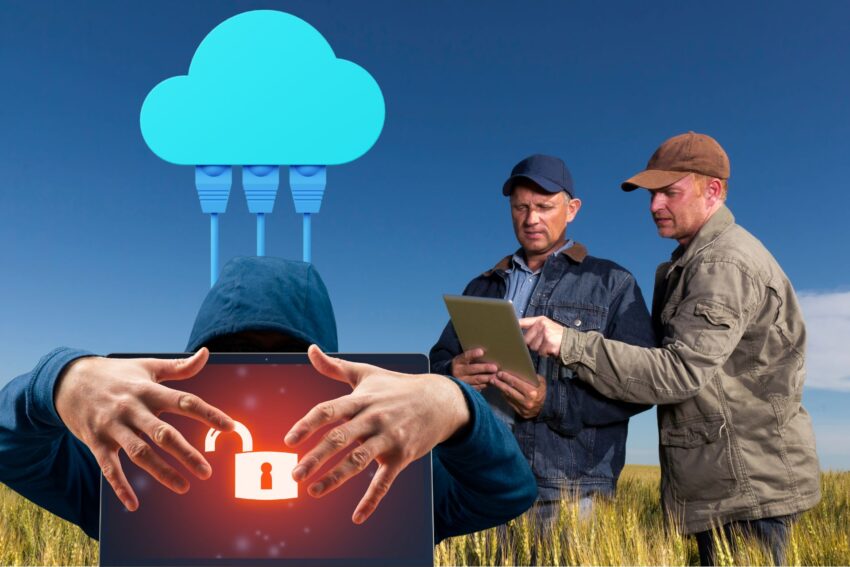
Attacking farmland and the systems that move food from field to market has long been a deliberate strategy in conflict. The war between Russia and Ukraine has made this reality impossible to ignore, both through physical strikes on grain storage, ports, and transport routes and through cyber operations that target the digital backbone of production and logistics. American farmers and the agencies that oversee agriculture cannot treat these lessons as distant. Foreign state actors angered by U.S. foreign policy or opportunistic criminal groups seeking ransom payments already view U.S. agriculture as a high-value target. A successful campaign could disrupt planting and harvest windows, halt processing, freeze transportation, and undermine national food security.
In Ukraine, Russian forces have repeatedly struck grain infrastructure. Missile and drone attacks have damaged ports, warehouses, and vessels carrying agricultural commodities, destroying hundreds of thousands of tons of product and impairing export capacity that once helped feed much of the world. Cyber operations have expanded the toolkit. In 2025, the Russian state-linked group Sandworm deployed data-wiping malware against Ukrainian entities in the grain sector, along with energy, logistics, and government targets. The intent appears clear: weaken a key source of export revenue and economic resilience during wartime. Similar hybrid approaches appear in Russian and Chinese military thinking that treats disruption of food systems as a component of broader conflict.
The United States is not immune. Modern American farming depends on connected technologies that raise efficiency while expanding the attack surface. GPS-guided tractors and combines, sensor networks for soil and crop monitoring, automated irrigation, drones, livestock management software, and cloud-based farm management platforms all rely on data integrity and continuous connectivity. A compromised system can alter planting rates, misdirect fertilizer or water applications, disable equipment during critical seasons, or inject false data into decision tools. Processing and distribution add further risk. Just-in-time logistics, industrial control systems in meatpacking and grain handling facilities, and software that coordinates cooperatives leave little margin for downtime.
Documented incidents illustrate the stakes. In 2021, a ransomware attack on JBS, the world’s largest meat processor, forced the temporary shutdown of U.S. beef plants that handled nearly one-fifth of national production. The same year, the Iowa grain cooperative NEW Cooperative faced a ransomware demand of roughly $5.9 million after attackers encrypted systems that managed feed schedules and logistics for livestock. More recent data from the Food and Agriculture Information Sharing and Analysis Center show sustained pressure: 212 ransomware incidents hit the food and agriculture sector in 2024, rising to 265 in 2025. Groups such as Qilin, Akira, and CL0P have been prominent. Attacks often exploit phishing, exposed vulnerabilities, or weak configurations on operational technology. Nation-state actors from China, Russia, and Iran have probed agricultural systems and related critical infrastructure, sometimes prepositioning for potential future disruption. Chinese-linked activity has raised particular concern around technology supply chains and farmland proximity to sensitive sites.
The economic and security consequences of a larger campaign would be severe. Timing an attack for planting or harvest could slash yields. Disrupting fertilizer distribution, seed platforms, or grain elevators could cascade through markets already stressed by weather and global demand. Livestock operations face acute risk: control of climate systems in poultry houses or feed systems could produce rapid, large-scale animal losses. Beyond direct production, theft of proprietary yield data, genetic information, or operational maps could advantage foreign competitors. Because agriculture contributes meaningfully to U.S. GDP and employment while underpinning broader food security, the sector qualifies as critical infrastructure. Adversaries understand this.
Government and industry responses have accelerated but remain incomplete. The USDA released its National Farm Security Action Plan in 2025, explicitly linking farmland ownership restrictions, foreign investment screening, and protection of agricultural critical infrastructure against cyber threats. The department maintains a Cybersecurity and Privacy Operations Center and participates in broader information-sharing efforts. The Food and Ag-ISAC provides threat intelligence and best practices. Legislation such as the Cybersecurity in Agriculture Act has been introduced to create regional research and education centers focused on agricultural cybersecurity. CISA and the FBI have issued repeated warnings about ransomware and industrial control system risks, urging stronger passwords, multifactor authentication, and network segmentation. Partnerships with the Department of Defense and DARPA aim to accelerate protective technologies.
These steps are necessary yet insufficient for the scale of the problem. Many individual farms and smaller cooperatives lack dedicated IT staff, cyber insurance, or the capital to harden systems quickly. Legacy equipment and internet-exposed operational technology remain common. Adoption of precision agriculture continues to outpace security training and standards. Information sharing has improved but still faces cultural and legal hurdles between government and private operators. Foreign-made components in drones, sensors, and software introduce supply-chain risks that are difficult for any single producer to evaluate.
Farmers themselves must treat cybersecurity with the same seriousness as physical farm security or weather risk. Practical measures include regular software updates, network segmentation that isolates equipment controls from business systems, strong authentication, offline backups of critical data and configurations, employee training against phishing, and participation in sector information-sharing groups. Larger agribusinesses and cooperatives should conduct penetration testing of both IT and operational technology environments and develop recovery plans that account for seasonal timing. Technology vendors bear responsibility for shipping products with secure defaults rather than leaving configuration to end users who may lack expertise.
Policymakers should expand tailored assistance for smaller producers, accelerate standards for agricultural IoT and precision equipment, strengthen attribution and deterrence against state-sponsored actors, and ensure that critical infrastructure designations translate into concrete support rather than paperwork. Research into resilient, less-connected systems for essential functions can reduce single points of failure. Transparency around foreign ownership and technology dependencies must continue.
The parallel with Ukraine is not exact. The United States is not under conventional bombardment. Yet the principle holds: agriculture is a strategic domain, and digital systems now form part of its defenses. Ignoring that reality invites the very disruptions adversaries have already demonstrated they are willing to pursue. American farmers produce the abundance that underwrites national strength. Protecting the technology that makes that production possible is no longer optional. It is a requirement of national security.