

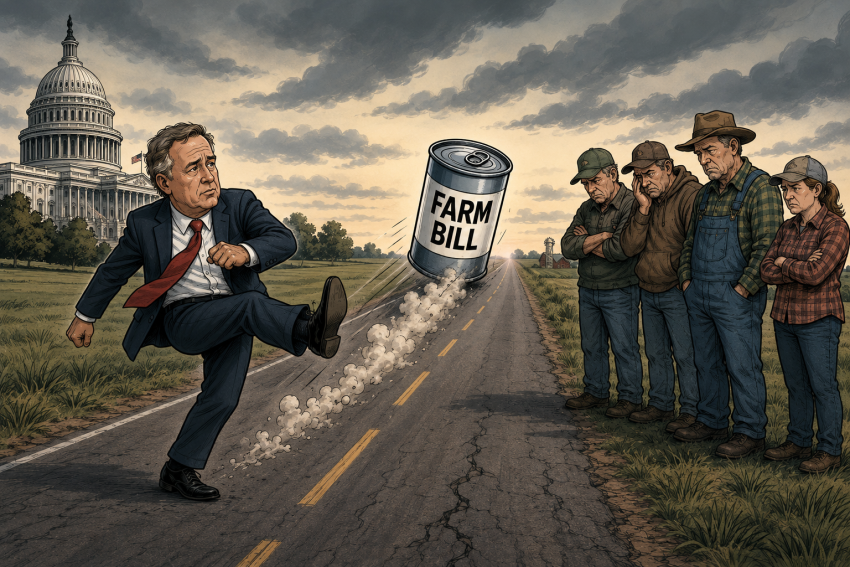
For American farmers and ranchers, the Farm Bill has become a painful exercise in déjà vu. The Agriculture Improvement Act of 2018, the last comprehensive five-year reauthorization of U.S. farm and food policy, expired on September 30, 2023. Congress has since extended it three times on a one-year basis: first into FY2024 and crop year 2024, then FY2025 and crop year 2025, and most recently in November 2025 to cover FY2026 through September 30, 2026.
That means producers have operated under 2018-era rules for far longer than intended, even as input costs soared, markets swung wildly, trade tensions flared, and weather extremes intensified. Core safety-net programs, conservation tools, research authorities, rural development, and specialty-crop supports have limped along under short-term patches or partial fixes. The pattern is clear: gridlock, temporary extensions, and uncertainty for the people who grow the nation’s food.
Why It Keeps Failing
The traditional Farm Bill was once a rare bipartisan workhorse. It bundled commodity supports, crop insurance, conservation, trade, research, rural development, and the massive Supplemental Nutrition Assistance Program (SNAP) into one package. That structure created natural coalitions. Farm-state lawmakers needed urban and suburban votes for nutrition funding, and vice versa.
Polarization shattered that bargain. Disputes over SNAP eligibility, work requirements, benefit levels, and cost-sharing have repeatedly collided with demands for higher reference prices, stronger crop insurance, and more robust commodity safety nets. Climate and conservation funding, animal-welfare rules, pesticide language, ethanol (E15), and specialty-crop priorities add further flashpoints.
In 2023 and 2024, neither chamber produced a full bill that could clear both houses. The House Agriculture Committee advanced a version in 2024 that never reached a floor vote amid internal Republican disagreements and Democratic opposition. Senate efforts stalled over cost and priorities.In 2025, Republicans used the budget reconciliation process (the One Big Beautiful Bill Act, or OBBBA) to lock in major pieces without needing 60 Senate votes. That law reauthorized and boosted many commodity programs and crop insurance elements through crop year 2031, adjusted some conservation funding, and enacted significant SNAP reforms and spending reductions. It was not a full Farm Bill. Many programs outside the reconciliation rules, including research, certain rural development and trade authorities, full conservation reauthorizations, and discretionary pieces, were left hanging. A further one-year extension of remaining 2018 authorities followed in late 2025.
By 2026, the House finally passed the Farm, Food, and National Security Act of 2026 (H.R. 7567) on April 30. It addressed many outstanding reauthorizations while navigating the changes already made in reconciliation. The Senate Agriculture Committee, under Chairman John Boozman (R-AR), released its own draft and scheduled a markup for August 6, 2026. That effort failed on a 10-11 vote. Democrats, led by figures such as Sen. Cory Booker, rejected the package over SNAP cost-sharing provisions for states, specifically the length of any delay before error-rate-based state contributions take effect. Concessions offering a one-year delay proved insufficient for those seeking two years or broader restoration of prior SNAP funding.
American Farm Bureau Federation President Zippy Duvall called the outcome deeply disappointing, noting the multiyear losses facing producers and the national-security stakes of a reliable food supply. He urged senators to return to the table, warning that the window this year may be closing.
Underlying drivers include deep partisan distrust after reconciliation shifted large pieces of policy unilaterally, narrow margins and absences (including prolonged absence of key members) that make committee votes razor-thin, competing regional and commodity interests (corn and ethanol versus others, livestock rules, specialty crops), the loss of the old logrolling incentive once major mandatory spending was handled outside the regular Farm Bill process, and broader congressional dysfunction involving short-term continuing resolutions, shutdown brinkmanship, and election-year caution.
Farmers are left planning with outdated tools. Programs designed in 2018 do not fully reflect today’s cost structure, risk environment, or market realities. Conservation, research, beginning-farmer supports, and many rural initiatives face repeated funding cliffs or uncertainty.
Can Congress Actually Deliver in 2026 or Will They Kick the Can Again?
As of early August 2026, the current extension runs only through September 30, 2026. The House has a bill. The Senate committee is in indefinite recess after the failed markup, with talk of trying again in September. Chairman Boozman has framed the moment as now or never for a 2026 bill.
Realistic prospects for a full, multi-year reauthorization this calendar year look poor. The Senate needs bipartisan support to clear the 60-vote threshold in most scenarios. The recent collapse over SNAP details shows the gap remains wide. The House has already left for August recess. The Senate’s schedule is compressed. Midterm dynamics and competing priorities (appropriations and other must-pass bills) further reduce bandwidth.
The path of least resistance remains familiar: another short-term extension of the 2018 framework or the residual pieces not already covered by reconciliation, attached to a continuing resolution or other end-of-year vehicle. That would leave producers stuck with a patchwork of stronger commodity supports through 2031 from the 2025 law, but continued short-term authority and under-investment in the broader suite of programs that make a true Farm Bill comprehensive.
Some observers already speak of a post-Farm Bill era in which major mandatory pieces move through reconciliation or appropriations while the rest limps along via annual patches. That approach sacrifices the long-term certainty, program updates, and rural investments that a proper reauthorization provides.
Farmers, ranchers, and rural communities need more than another one-year Band-Aid. They need updated reference prices and safety-net tools calibrated to current costs, reliable conservation and research funding, trade and market development authorities, and a nutrition title that can actually pass. Congress has repeatedly demonstrated the capacity to extend the status quo under deadline pressure. It has so far failed to demonstrate the capacity or the will to negotiate a durable, bipartisan replacement.
Whether September brings a genuine compromise or yet another extension will determine if 2026 finally breaks the cycle or simply adds another year to the ledger of delay. History since 2023 offers little reason for optimism. The people who feed the country deserve better than repeated failure and kicked cans.