

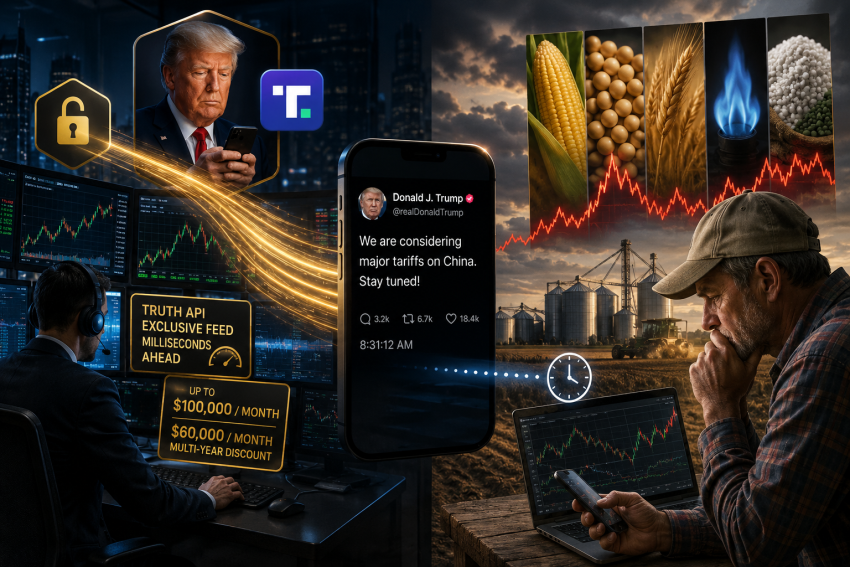
On August 1, 2026, Trump Media & Technology Group launched Truth API, a paid data feed that delivers posts from Truth Social’s highest-ranking accounts, most notably President Donald Trump’s, to subscribers milliseconds ahead of the public. Pricing discussions put the cost at up to $100,000 per month, with a discounted $60,000 option for multi-year commitments. By the first full trading day (Monday, August 3), the service was live for the financial firms willing to pay.
The company frames it as a standard commercial product. Interim CEO Kevin McGurn noted that “markets already move on Truth Social posts” and positioned the API as a licensed, low-latency feed for organizations “most impacted by the cost of a delay in information,” explicitly including high-frequency and algorithmic trading firms. Other platforms sell similar data feeds. The difference is structural: the sitting president is both the platform’s dominant content source and its largest shareholder (roughly 41% stake via trust). His posts routinely move stocks, currencies, energy, and commodities.
Critics, including Democratic lawmakers and ethics observers, call this a pay-for-play arrangement that privatizes a speed advantage on information the president himself generates. Gavin Newsom described it as “literally selling early access to market-moving information.” Senators have urged the SEC to examine whether it crosses into improper dissemination of material non-public information. Defenders note the posts become public almost simultaneously and that the edge is measured in fractions of a second, which is valuable mainly to sophisticated HFT shops that already race for any latency edge. The optics remain stark, though, as the executive branch’s most market-sensitive communicator is monetizing preferential access through a company he substantially owns.
Commodity Markets and the Information Asymmetry
Agriculture and fertilizer markets are particularly sensitive to geopolitical and trade signals. A presidential post hinting at escalated military action, new tariffs, sanctions relief, or a major trade deal with China can reprice corn, soybeans, wheat, and nitrogen/phosphate inputs within minutes. China’s demand and policy choices heavily influence global soy and corn balances; energy prices and conflict risk affect fertilizer production costs and shipping. High-frequency traders with the paid feed can position before the broader market digests the same words. Retail participants, farmers, cooperatives, and smaller commercial hedgers remain behind the curve by design.
This is not classic insider trading under traditional securities law definitions, as the information is not “non-public” in the classic sense once posted, merely delayed for non-subscribers. It is, however, an unprecedented commercialization of the president’s real-time policy signaling power. Announcements that once reached markets through official channels, press briefings, or simultaneous social media now carry a paid fast lane whose proceeds flow, in part, to the president’s company. Anyone without the subscription operates at a structural disadvantage when reacting to the same official communications.
Whether this constitutes illegal market manipulation or merely aggressive monetization of a private platform will likely be tested in oversight and potential regulatory scrutiny. What is already clear is the asymmetry it creates: those able and willing to pay six figures monthly gain a measurable speed edge on information that can move commodity prices, while everyone else (farmers managing basis risk, cooperatives hedging inputs, smaller traders) receives the signal later. In markets where milliseconds and position sizing determine who captures the move, that difference is not theoretical.