

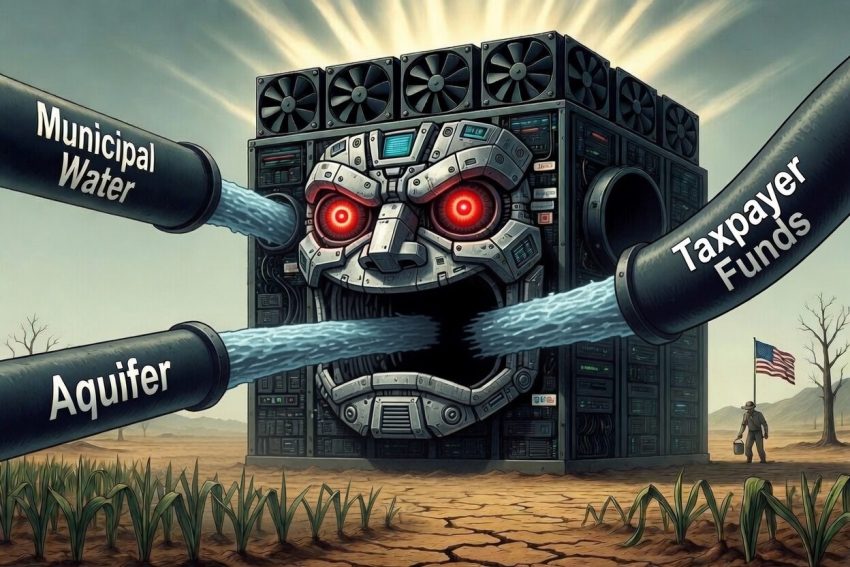
While farmers across America face mandates to cut water use and average citizens are shamed into shorter showers and brown lawns, Big Tech data centers are guzzling freshwater at staggering rates. As drought concerns mount in key agricultural regions, questions are rising about whether the explosive growth of artificial intelligence, mass surveillance, and cloud computing is quietly reshaping our water supply in ways that official narratives ignore.
Data centers require enormous amounts of water for cooling their power-hungry servers. A single large facility can consume millions of gallons per day, with projections showing demand exploding as AI adoption accelerates. hyperscale centers operated by companies like Microsoft, Google, and Amazon have been responsible for significant withdrawals from local water systems, sometimes in areas already facing scarcity. Reports indicate that training one advanced AI model can use water equivalent to what hundreds of households consume in months. Yet while rural communities are told to sacrifice for the greater good, these tech giants often secure exemptions or build in regions where water access is negotiated behind closed doors.
Defenders of the industry argue that this water is not truly lost. They claim it evaporates and eventually returns to the natural water cycle through rainfall. In theory, that sounds reassuring. In practice, the timing, location, and scale matter. When massive volumes of water are vaporized in concentrated industrial zones, especially in arid or semi-arid areas chosen for cheap power and land, that moisture may not fall back where it is most needed for agriculture. Some researchers suggest that localized changes in humidity and atmospheric patterns could contribute to altered precipitation, effectively sequestering water away from traditional farming belts. Instead of replenishing aquifers and rivers that feed cropland, the vapor might shift rainfall patterns in unpredictable ways.
Of course, the mainstream response is predictable. Leftist commentators and climate activists immediately point to global warming as the sole culprit, demanding more green energy mandates and carbon taxes while downplaying any role from the very tech infrastructure they celebrate. Yet the timeline does not perfectly align. Permadrought conditions and erratic weather have intensified alongside the breakneck expansion of data centers, not merely alongside gradual temperature shifts. It appears more immediate and direct than distant models of planetary warming suggest.
This imbalance raises deeper concerns. On one level, it may simply be an unintended side effect of high-tech development. The rush for artificial intelligence supremacy has created blind spots where resource intensity is overlooked in favor of innovation narratives. Farmers, who produce the food that sustains civilization, are treated as obstacles to progress rather than stewards of the land.
But some see darker motives. Echoes of the James Bond film Quantum of Solace, where villains scheme to control water resources for profit and power, feel less fictional today. Figures like former Nestle CEO and World Economic Forum board member Peter Brabeck-Letmathe have openly discussed water as a marketable commodity rather than a basic human right, sparking outrage among those who remember his comments on privatizing water supplies. Without reliable water, crops fail, food prices soar, and societies destabilize. Thirst kills quickly. Famine follows. Theories that this could align with long-stated goals of reducing human population numbers among certain elite circles are dismissed as conspiracy by the same voices that benefit from expanded tech dominance. Yet the pattern of policies that burden food producers while shielding data centers deserves scrutiny, not reflexive denial.
Agriculture already operates on thin margins. Mandated water restrictions during dry periods threaten harvests, livestock, and rural economies. Meanwhile, tech companies project continued exponential growth in water use, with some estimates forecasting data centers could claim up to 10 percent or more of freshwater in stressed regions within years. This is not sustainable coexistence. It is competition for a finite resource where one side holds political and financial power.
Solutions exist but require honesty. Greater transparency on data center water consumption, incentives for dry cooling technologies or wastewater recycling, and balanced policies that do not treat farmers as expendable would be starts. Prioritizing food security over endless digital expansion is not anti-technology. It is pro-civilization.
The permadrought narrative must expand beyond convenient climate explanations. If Big Tech’s thirst is contributing to dwindling supplies for American agriculture, citizens and policymakers need to confront it directly before fields turn to dust while server farms hum along uninterrupted. The water we save today may determine what we eat tomorrow.