

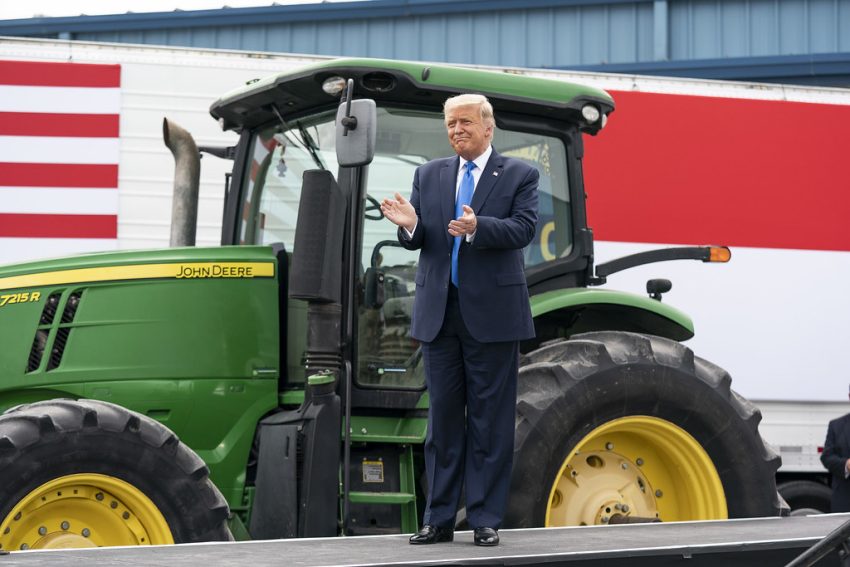
Trump’s recent appearance at the White House, where he addressed hundreds of farmers on the South Lawn while pausing to admire a gleaming gold tractor, was meant to signal strong support for American agriculture. He touted new regulatory relief on equipment, expanded loan guarantees, and biofuel policies aimed at lowering costs. Yet his offhand remarks about farmers’ finances left many in the industry feeling dismissed rather than helped.
During the event on March 27, Trump interrupted his own comments on cutting farmer costs to gush over the gold-wrapped tractor parked below. “That’s a beautiful tractor. That’s a gold tractor. Somebody had me in mind,” he said, even joking that it might be a personal gift. The lighthearted moment stood in sharp contrast to the serious struggles facing many in the crowd. Moments later, when discussing the $12 billion in bridge payments his administration announced in December, Trump told the farmers, “I just gave you 12 billion dollars. … You make enough money. It doesn’t matter to you, right?” Cheers followed the aid mention, but the crowd fell largely silent after the line about their income. He turned to Agriculture Secretary Brooke Rollins for confirmation before adding a jab at the previous administration.
Trump: "We love the American farmer. I just gave you $12 billion. I don't know if you know that or not. You make enough money, it doesn't matter to you, right?" pic.twitter.com/6BdIhv9qjy
— Aaron Rupar (@atrupar) March 27, 2026
The timing could hardly have been worse. Farm bankruptcies surged 46 percent in 2025, reaching 315 Chapter 12 filings, the second straight year of increases. Many operations in the Midwest and Southeast were hit especially hard. USDA forecasts for 2026 show net farm income dipping slightly to $153.4 billion, with continued pressure from low commodity prices, high debt loads, and elevated production expenses. A generational downturn is underway, and large numbers of farmers are not expected to turn a profit this year after similar losses in 2025. For many, breaking even feels like an optimistic target.
Trump framed the $12 billion bridge payments as a generous gift from his administration to help farmers weather market disruptions. In reality, the aid package, with $11 billion directed primarily to row crop producers through the Farmer Bridge Assistance Program, served as a temporary bandage for losses tied to trade tensions. The payments were explicitly linked to the impacts of tariffs, which disrupted export markets for soybeans, corn, and other commodities. Critics argue the assistance addressed problems the tariffs themselves helped create, offering short-term cash flow relief while longer-term policy shifts, such as updated reference prices in the farm bill, were still months away.
Adding to the strain is the ongoing conflict with Iran, which has driven sharp increases in key input costs. Disruptions in the Strait of Hormuz, a critical route for roughly one-third of global fertilizer trade, have pushed urea and other nitrogen fertilizer prices significantly higher, with some reports showing jumps of 20 to 50 percent or more since the escalation. Diesel prices have also climbed, sometimes doubling in affected regions, raising fuel expenses for planting, harvesting, and transporting goods. These spikes come at a precarious time, squeezing margins even further for operations already facing thin or negative profits.
Many farmers welcome any attention to their challenges, including promises of regulatory relief on diesel emissions equipment and higher biofuel blending requirements. Government payments have become a larger share of farm income in recent years, providing essential support. At the same time, a growing number are recognizing that policies from both sides of the aisle often contribute to the very problems they face. Tariffs and trade wars from one administration, combined with regulatory burdens or market interventions from another, can amplify volatility in input costs, export access, and commodity prices. Whether the source is left or right, repeated cycles of disruption followed by aid packages leave producers questioning the long-term sustainability of relying on Washington for fixes.
The gold tractor may have brought a brief smile to the president, but for farmers staring down another tough season, the real need is for policies that deliver stability rather than spectacle. As bankruptcies climb and input costs rise, lip service and one-time payments offer limited comfort when the underlying pressures keep mounting.