

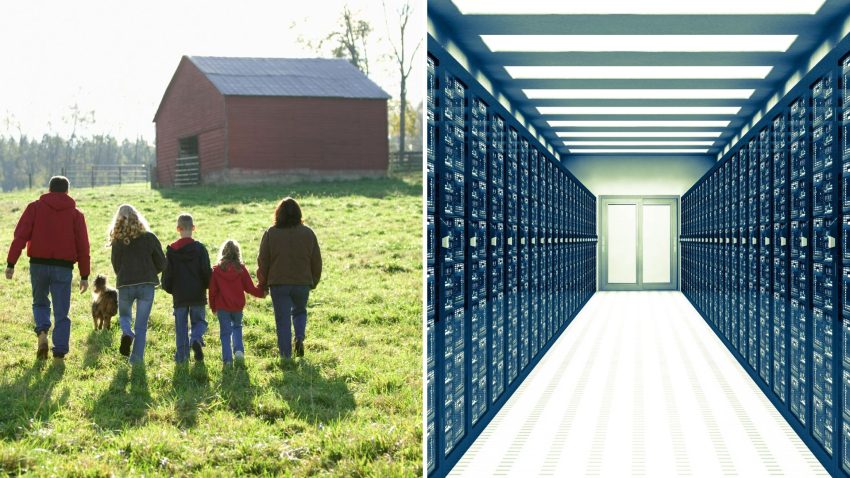
Rural farming communities across the Midwest and beyond are drawing a hard line. They are rejecting multimillion-dollar offers from tech giants and fighting rezoning battles to protect the land, water, and power that keep American agriculture alive. Data centers, fueled by the artificial intelligence boom, are snapping up prime farmland at record prices. They consume staggering amounts of water and electricity, drive up costs for everyone else, and deliver almost nothing back to the towns and families who bear the burden.
One hyperscale data center can swallow 200 to 500 acres of land, with some campuses stretching to 800 or 1,000 acres or more. That is productive cropland taken out of food production forever, replaced by concrete, steel buildings, and paved lots. In Wisconsin, one farmer turned down an $80 million offer for his land. In Pennsylvania, another rejected $15 million for 50 years of family farmland. In Kentucky, an 82-year-old woman said no to $33 million for 650 acres. Developers keep coming because rural ground is cheap, flat, and easy to rezone compared with city lots. Yet once the deal closes, the soil that once grew corn or soybeans now cools servers instead.
Water use is even more alarming. A typical large data center pulls 300,000 gallons per day for evaporative cooling. The biggest ones demand up to 5 million gallons daily, the same amount used by a city of 50,000 people. In Newton County, Georgia, a single Meta facility already consumes 500,000 gallons every day, about 10 percent of the entire county’s supply. Some proposed projects there eye 6 million gallons per day, more than double current county totals. Nationwide, U.S. data centers used roughly 17 billion gallons in 2023. Projections show that figure could double or quadruple by 2028 as AI workloads explode. Farmers who irrigate crops or raise livestock compete directly for the same limited groundwater and surface supplies. In drought-prone or stressed regions, that competition threatens harvests and livestock operations that have sustained rural economies for generations.
Electricity demand is the third hammer blow. A single hyperscale data center can use six to 10 times as much power as the city of Brookings, South Dakota, with a population of 25,031. That is a town with a major university, manufacturing plants, and thousands of homes. Some AI-focused centers draw as much electricity as 100,000 households. Utilities in places like South Dakota and North Dakota are scrambling to build new substations, transmission lines, and even extra generation capacity. In Virginia, electricity prices near data center clusters have jumped as much as 267 percent over five years. Rural ratepayers, including farms and small businesses, end up subsidizing the grid upgrades while data center operators often negotiate special low rates or massive tax breaks. In many cases, the added demand pushes wholesale power prices higher for everyone, and the extra infrastructure costs get spread across residential and agricultural bills.
The promised local benefits rarely materialize at scale. Construction creates temporary jobs, but permanent positions go mostly to specialized tech workers who commute or relocate from cities. Tax revenue sounds good on paper, yet generous state incentives often wipe out much of the gain. Meanwhile, the grid strain, water competition, and lost farmland hit farmers and neighbors immediately and permanently. Rural electric cooperatives, such as Sioux Valley Energy, have set up special rate structures to try to shield other customers, but the sheer scale of new projects still pressures the system. Northern climates attract these facilities for cheaper cooling, which is why the upper Midwest has become a prime target.
Farmers and local leaders are pushing back with everything they have. They are preserving land through conservation programs, voting down rezoning requests, and rallying neighbors at county meetings. In Wisconsin, residents organized against a proposed AI data center near family farms. In Pennsylvania and Kentucky, landowners simply said the money was not worth giving up their way of life or harming their communities. These stands are not against technology itself. They are against letting one industry consume the resources that another industry, agriculture, uses to feed the nation.
Data centers are not going away. The AI surge guarantees more of them. But rural America does not have to roll over. Communities that demand strict water limits, full-cost electricity rates with no subsidies, and protections for productive farmland can slow the land grab and force better planning. The alternative is clear: more concrete where crops once grew, higher bills for farm families, and water tables stressed beyond recovery. Farmers built this country’s food system. They are not about to let servers replace it without a fight.