

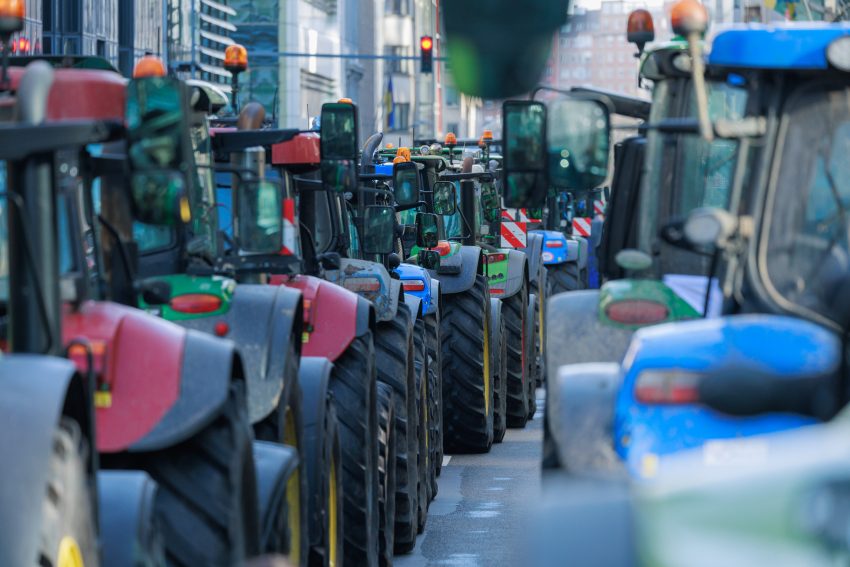
As 2025 draws to a close, Europe’s farmers are once again taking to the streets in force. Just weeks ago, in mid-December, thousands of tractors descended on Brussels. They blocked roads, lit fires, and clashed with police amid protests against the EU-Mercosur trade deal. Farmers hurled potatoes and eggs, burned tires, and demanded protection from what they see as unfair competition from cheaper South American imports that do not face the same stringent environmental and regulatory standards. This was not an isolated event. Protests spread to France, where farmers blocked highways over cattle culls for lumpy skin disease and broader grievances. They were also echoed in Eastern Europe over duty-free Ukrainian imports and bureaucratic red tape.
These actions build on years of unrest. The root cause lies in the EU’s Green Deal policies: nitrogen emission caps, fuel taxes, land set-asides, and reporting requirements that many farmers argue ignore on-the-ground realities. Even regenerative, low-input operations have been hit hard, as rules often fail to distinguish between industrial and sustainable practices. The result includes rising costs, forced farm closures, and a sense that policymakers in Brussels are waging war on rural livelihoods.
American farmers should pay close attention. Europe’s crisis is not just about trade deals or disease outbreaks. It is a cautionary tale of overregulation, uneven global competition, and policies that prioritize ideological goals over food security and farm viability. While the current U.S. administration has provided some breathing room by rolling back elements of the “green agenda,” including ending federal subsidies for solar and wind projects on productive farmland and canceling climate-smart farming programs, threats remain.
Prime agricultural land continues to be eyed for solar arrays and carbon capture pipelines. Despite USDA restrictions announced in 2025 blocking taxpayer dollars for solar panels on viable farmland, private developments and state-level incentives persist. They convert cropland into energy infrastructure. Carbon dioxide pipelines, often tied to ethanol plants and carbon sequestration efforts, cut through rural America. They raise eminent domain concerns and long-term soil impacts.
Meanwhile, family farms, the backbone of U.S. agriculture and making up 95% of all operations, are under severe strain. Farm bankruptcies surged in 2025, with Chapter 12 filings already exceeding prior years amid falling commodity prices, high inputs, and trade disruptions. Thousands of operations are at risk of foreclosure, accelerating consolidation and the loss of independent producers.
The reprieve from heavy federal green regulations could vanish overnight with a change in administration. Past policies under the Inflation Reduction Act poured billions into “climate-smart” initiatives, often criticized as burdensome and misaligned with practical farming. A future shift could revive nitrogen rules, carbon taxes, or restrictive land-use mandates, mirroring Europe’s path.
America’s farmers have dodged the worst of Europe’s regulatory onslaught so far, thanks to recent policy wins prioritizing production over ideology. But the encroachment on farmland, rising insolvencies, and political volatility serve as red flags. Europe’s tractors in the streets are a wake-up call: ignore the warnings, and the U.S. could face its own agricultural revolt. Protecting prime soil, supporting family operations, and ensuring fair trade are not just economic issues. They are essential for national food security and rural vitality. U.S. farmers must stay vigilant. The fight for the future of farming is far from over.